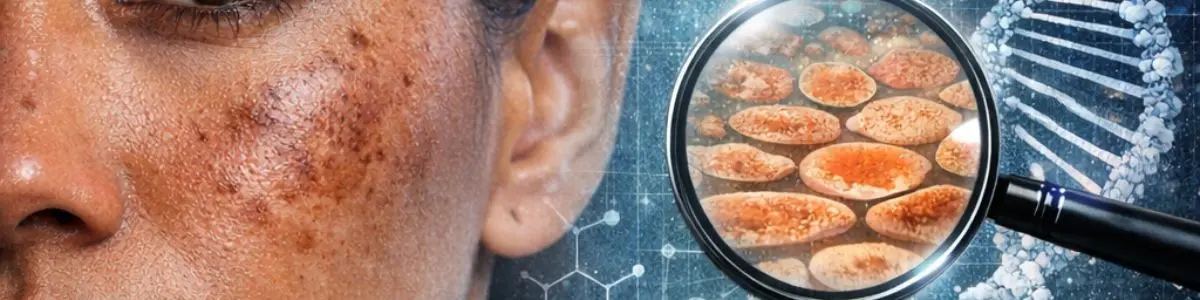
Why Your Melasma or Dark Spots are Getting Darker: An Investigative Report
Pigmentation, melasma, or dark spots, whatever the label, it all comes down to one biological fact: your skin is overproducing melanin in specific areas. And yes, it’s often more noticeable in skin of color because even small amounts of inflammation can trigger pigmentation.
You might know the “top” ingredients everyone talks about to fight pigmentation, but here is the truth: they often fail. My investigation has uncovered the missing piece—Your Skin Barrier. If your barrier is compromised or dehydrated, even the most expensive “gold-standard” actives cannot deliver results.
The Darkening Mystery: Why Brighteners Sometimes Backfire
Have you noticed your skin looking darker after starting a new skin brightening product? Or perhaps your spots fade, only to return with a vengeance? This boils down to barrier health.
When your “shield” is broken, your melanocytes (pigment-producing cells) go into survival mode. I explore this “Darkening Mystery” in detail in my investigative blueprint.
Why Your Melasma or Dark Spots are Getting Darker
This clinical guide tells you exactly how to read how your “skin is feeling” so you know when to apply actives and when to focus on repair.
With over 20 years of experience as a Legal Journalist, I have spent my career investigating evidence and uncovering truths. Now, as a Skincare Formulator, I apply that same rigor to clinical data.
The Global Climate Factor: Heat as the “Silent” Trigger
While many focus purely on UV light, research reveals a broader culprit: Environmental Heat. Whether you are in London, New York, or Johannesburg, the cellular response to trauma is identical. According to clinical studies on skin biology, heat from cooking, hot showers, or extreme temperatures acts as a silent trigger that wakes up dormant melasma or dark spots—even if you are wearing sunscreen. The evidence is clear: according to a landmark study on the specific contributions of seven factors involved in health and beauty, our lifestyle choices and environmental heat exposure are often more responsible for darkening pigment than genetics alone.
The Barrier-Inflammation-Pigment Axis
We must stop treating pigmentation as a surface defect and start seeing it as an immunological response.
The Barrier Signal: When your epidermal barrier is compromised, Transepidermal Water Loss (TEWL) increases. This is a measurable indicator of dysfunction that activates inflammatory mediators.
The Inflammatory Loop: These signals tell your melanocytes to pump out pigment as a biological shield.
The Trauma Cycle: If you are “chopping and changing” products or over-exfoliating, you are unknowingly resetting the trauma and sustaining the inflammation.
Investigative Ingredient Analysis: Beyond the Hype to understand Why Your Melasma or Dark Spots are Getting Darker
To stop the darkening of melasma or dark spots, you must prioritize Skin Intelligence over marketing.
Retinoids: While effective for aging, the contraindications for high-strength formulas include reactive, sensitized skin. Pushing “retinol every night” can quietly increase inflammation.
Anti-Inflammatories: The recovery phase is non-negotiable. You cannot fix pigment while the “alarm” of inflammation is still ringing.
Barrier-Repair Actives: You must strengthen the shield before aggressive correction.
The Investigative Diagnostic: Identify Your Depth
You cannot treat what you haven’t diagnosed. Use these two simple tests from my research to identify your melasma or dark spots:
The Stretch Test: Gently stretch the skin at the dark spot. If the color stays the same or looks darker, it is Epidermal (surface). If it appears to fade, it is Dermal (deep).
The Border Test: Look at the edges. Sharp, well-defined borders usually indicate surface pigment. Fuzzy, grayish-blue edges are a hallmark of deep, complex cases like melasma.
From Complexity to Clarity
No one can “fix” your pigmentation but you. It requires stepping out of the cycle of skin trauma and into informed decision-making. For a structured presentation of my findings and the exact investigative routine to follow, you can access the full Pigmentation Truth: A Guide to Barrier Repair and Inflammation Control.