Why Your Melasma or Dark Spots are Getting Darker
Why Your Melasma or Dark Spots are Getting Darker: An Investigative Report
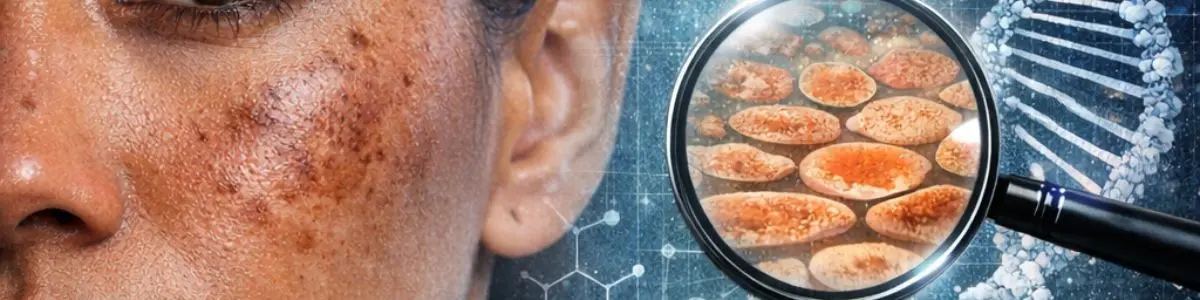
Melasma, post-inflammatory hyperpigmentation and other dark spots can look similar, but they do not always have the same cause. What they share is an increase or accumulation of melanin in the affected area. And yes, it’s often more noticeable in skin of color ; inflammation or injury can stimulate additional pigment production, and post-inflammatory marks can be more persistent in darker skin tones.
Our pick for stubborn pigmentation: the Melanin Breaker — a high-potency formula with 4-Butylresorcinol, Tranexamic Acid and SymWhite® 377 to help fade melasma and dark marks.
Are your dark spots getting darker despite everything you’re using? Read the Investigative Guide → Why Is My Melasma or Dark Spots Getting Darker?
You may already be using well-supported pigmentation ingredients and still not be getting the result you expected. That does not automatically mean the ingredient is useless — something else may be keeping the pigmentation active. One overlooked reason pigmentation can get worse is irritation and barrier disruption. If your routine is repeatedly leaving your skin burning, stinging, peeling or inflamed, the treatment itself may be contributing to new post-inflammatory pigmentation. Even well-supported pigmentation actives can be undermined if the routine is repeatedly irritating your skin.
The Darkening Mystery: Why Brighteners Sometimes Backfire
Have you noticed your skin looking darker after starting a new skin brightening product? Or perhaps your spots fade, only to return with a vengeance? If a brightening routine is making your skin sting, burn, peel or stay irritated, that irritation may be working against you. In pigmentation-prone skin, inflammation can stimulate additional melanin production and leave new dark marks.
When skin is repeatedly irritated or inflamed, inflammatory signals can stimulate melanocytes — the cells that produce melanin — to make more pigment. In other words, the treatment can end up creating another pigment trigger. I explore this “Darkening Mystery” in detail in my investigative blueprint.
Why Your Melasma or Dark Spots are Getting Darker
This investigative guide helps you look at how your skin is responding, so you can recognise when your routine may be causing irritation and when it may be time to simplify and focus on barrier support.
With over 20 years of experience as a Legal Journalist, I have spent my career investigating evidence and uncovering truths. Now, as a Skincare Formulator, I apply that same rigor to clinical data.
Can Heat Make Melasma Look Worse?
While many focus purely on UV light, Some people report that melasma looks worse with heat or flushing, but heat should not be treated as equivalent to UV exposure. Sunlight, including UV and visible light, remains one of the best-established external triggers for melasma.
The Barrier-Inflammation-Pigment Axis
We must stop treating pigmentation as a surface defect and start seeing it as an immunological response.
The Barrier Signal: When your epidermal barrier is compromised, Transepidermal Water Loss (TEWL) increases. This reflects a weakened barrier; if the resulting irritation produces ongoing inflammation, inflammatory signals can then stimulate pigment production.
The Inflammatory Loop: Inflammatory signals can stimulate melanocytes and increase melanin production, which can leave a darker mark after the inflammation settles.
The Trauma Cycle: If you keep changing products, over-exfoliating or repeatedly irritating the skin, you may keep creating new inflammation before the previous irritation has settled.
If Your Pigmentation Is Getting Darker, Ask Four Questions
- Is the original trigger still active? Acne, eczema, irritation, picking or another inflammatory problem can keep creating new marks.
- Is your routine irritating your skin? Burning, stinging, persistent peeling and inflammation can work against pigment treatment.
- Are you protecting against sunlight consistently? UV — and visible light in melasma — can keep pigmentation active.
- Are you treating the right type of pigmentation? Melasma, PIH and deeper pigmentation do not all behave in the same way.
And do not overlook sun protection. UV exposure can darken existing pigmentation and contribute to new pigment production. If you have melasma, visible light from sunlight can also matter, which is why a tinted sunscreen containing iron oxides can be useful.
Not sure whether to keep treating or simplify your routine? See our Pigmentation, Melasma & Chubaba treatment options and choose according to your skin, budget and goals →
Investigative Ingredient Analysis: Beyond the Hype to understand Why Your Melasma or Dark Spots are Getting Darker
To stop the darkening of melasma or dark spots, you must prioritize Skin Intelligence over marketing.
Retinoids: While effective for aging, the contraindications for high-strength formulas include reactive, sensitized skin. Pushing “retinol every night” can quietly increase inflammation.
Anti-Inflammatories: The recovery phase is non-negotiable. You cannot fix pigment while the “alarm” of inflammation is still ringing.
Barrier-Repair Actives: You must strengthen the shield before aggressive correction.
The Investigative Diagnostic: Identify Your Depth
You cannot treat what you haven’t diagnosed. Use these two simple tests from my research to identify your melasma or dark spots:
The Stretch Test: Gently stretch the skin at the dark spot. If the color stays the same or looks darker, it is Epidermal (surface). If it appears to fade, it is Dermal (deep).
The Border Test: Look at the edges. Sharp, well-defined borders usually indicate surface pigment. Fuzzy, grayish-blue edges are a hallmark of deep, complex cases like melasma.
From Complexity to Clarity
No one can “fix” your pigmentation but you. It requires stepping out of the cycle of skin trauma and into informed decision-making. For a structured presentation of my findings and the exact investigative routine to follow, you can access the full Pigmentation Truth: A Guide to Barrier Repair and Inflammation Control.
Your pigmentation getting darker does not automatically mean you need a stronger product — first work out what is keeping the pigment active.
Want the full investigation? → Why Is My Melasma or Dark Spots Getting Darker?
Ready to change your routine? → Build Your Pigmentation, Melasma & Chubaba Routine
Skin irritated from treatment? → Barrier Repair Cream
Explore the pigmentation & melasma guide
Melasma vs HyperpigmentationEpidermal vs Dermal — how deep?Why it's getting darkerYou are hereHow long does it take to fade?
How to remove ChubabaWhat to Use for HyperpigmentationTreatment for dark skinTreat melasma without hydroquinoneDoes microneedling help?
Pigmentation, Melasma & Chubaba SolutionsFind your routine by concernChubaba Dark Patch CorrectorMelanin BreakerGuide: Why is it getting darker?
Best Skin Brightening Ingredients10 actives compared · the hubAlpha Arbutin4-ButylresorcinolKojic Acid DipalmitateMulberry Root Extract