L-Glutathione Benefits for Skin
When people search for L-Glutathione benefits for skin, they are usually picturing dramatic whitening- but the honest answer is narrower. L-glutathione is one of the most searched skin-brightening ingredients in South Africa, and one of the most misunderstood. The evidence for glutathione lightening skin is real but it depends enormously on how you use it, and the routes people reach for most often — a capsule, or worse, an IV drip — are not equally well supported.
I want to walk through what the actual clinical trials found because you deserve to know which side of that gap your money is landing on.
Trying to fade dark marks, melasma or Chubaba rather than simply research glutathione? See our Pigmentation, Melasma & Chubaba solutions →
What L-glutathione actually is
Glutathione is a tripeptide — a small protein made of three amino acids (cysteine, glycine and glutamic acid). Your body already makes it. It is not an exotic import; it is one of the most important antioxidants your cells produce, and its day job is mopping up oxidative stress inside the cell.
The skin-lightening interest came later, and almost by accident. Patients taking glutathione for other reasons noticed their skin got lighter. That observation is what launched an entire industry.
How glutathione affects melanin
Glutathione does not bleach skin. It interferes with the manufacturing process.
Melanin comes in two forms: eumelanin (the dark brown-black pigment) and pheomelanin (the lighter red-yellow pigment). Glutathione appears to nudge production away from eumelanin and toward pheomelanin, while also inhibiting tyrosinase — the enzyme that kicks off melanin production in the first place. The mechanism is well described in a 2017 review in Clinical, Cosmetic and Investigational Dermatology.
So the theory is sound. The theory was never the problem. The problem is getting the glutathione to where the melanin is being made.
What the oral glutathione trials actually found
Glutathione is a peptide, and your digestive system is very, very good at dismantling peptides. In a 1992 study published in the European Journal of Clinical Pharmacology, researchers gave healthy volunteers a single oral dose of 3,000 mg of glutathione — an enormous dose, far beyond what any commercial supplement contains — and measured their plasma afterwards. Glutathione levels did not rise significantly. The researchers concluded that the systemic availability of oral glutathione is negligible in humans, because enzymes in the gut and liver break the tripeptide apart before it ever reaches your bloodstream intact.
That is a genuinely inconvenient finding for an industry built on swallowing the stuff. And yet, despite that absorption problem, clinical trials measuring actual skin outcomes — not just blood levels — have still found real effects. This is the messier, more honest picture: poor absorption on paper, measurable results in some trials.
The most directly relevant one is a 2012 randomised, double-blind, placebo-controlled trial published in the Journal of Dermatological Treatment (Arjinpathana & Asawanonda), which gave 60 healthy adults 500 mg of oral glutathione daily — the same daily total used in our own Brighten Up Glutathione Caps protocol — for 4 weeks. The result was a statistically significant reduction in melanin index, though only at 2 of the 6 body sites tested (the face and the sun-exposed forearm, not the whole body uniformly). Small study, single population, site-limited — but a real, measured, significant effect at a dose you can actually buy.
A separate 2017 randomised, double-blind, placebo-controlled trial gave healthy women a lower dose — 250 mg per day of either reduced glutathione (GSH), oxidised glutathione (GSSG) or a placebo — for 12 weeks. At that lower dose, the melanin index at facial and arm sites only tended to be lower in the glutathione groups compared to placebo, without reaching statistical significance, though some sites did show a significant reduction in wrinkles.
Put those two together and a pattern emerges: at a proper, clinically-tested dose (500 mg/day), oral glutathione has shown a real, statistically significant effect in as little as 4 weeks. Cut the dose in half, and the effect softens into a trend rather than a proven result. Dose matters. If you are taking glutathione capsules, that 2012 trial — real, modest, and specific to two body sites — is the honest, evidence-backed benchmark, not a marketing promise of all-over transformation.
Topical glutathione: the cleanest evidence
In a double-blind, placebo-controlled split-face trial published in Clinical, Cosmetic and Investigational Dermatology, 30 healthy women applied a 2% oxidised glutathione (GSSG) lotion to one side of the face and a placebo lotion to the other, twice daily for 10 weeks. Split-face design is the gold standard here, because each woman acts as her own control — same diet, same sun exposure, same everything, with only the product differing.
The melanin index on the glutathione side was significantly lower than the placebo side, and the difference held from the early weeks right through to week 10. The treated sides also showed increased moisture in the stratum corneum (the outermost layer of skin) and improved smoothness. One participant had mild redness on days 2 and 3 that resolved on its own.
Topical application is applied directly to the skin, so it does not have to pass through the digestive system first. This means more of the ingredient reaches the area you are trying to treat. In many studies, researchers use a “split-face” design, where one side of the face receives the treatment and the other side does not. This makes it easier to see whether the ingredient is actually making a difference.
For this reason, topical glutathione currently has the strongest scientific support of the three methods—topical, oral, and injectable. However, having the strongest evidence does not mean it is the only option that works. Studies on oral glutathione have also shown improvements in skin brightness and pigmentation when used at the right dose.
L-Glutathione Benefits for Skin- IV drip??

Intravenous glutathione “whitening drips” are widely available across South Africa, and I want to be blunt about them.
The Philippine FDA — regulating the market where glutathione whitening is most entrenched — issued a formal public advisory warning against the use of glutathione as a skin-lightening agent by injection. Documented adverse effects reported in the literature include liver, kidney and nervous-system toxicity, thyroid dysfunction, potentially fatal Stevens-Johnson syndrome and toxic epidermal necrolysis (severe reactions in which the skin blisters and detaches), air embolism, and sepsis from unsterile administration.
There are no published clinical trials evaluating injectable glutathione for skin lightening, and no established dosing guidelines. You are being asked to accept a real risk in exchange for an unmeasured benefit. That is not a trade I would make, and it is not one I would ever recommend to a reader — unlike the oral and topical routes above, both of which have actual controlled trials behind them.
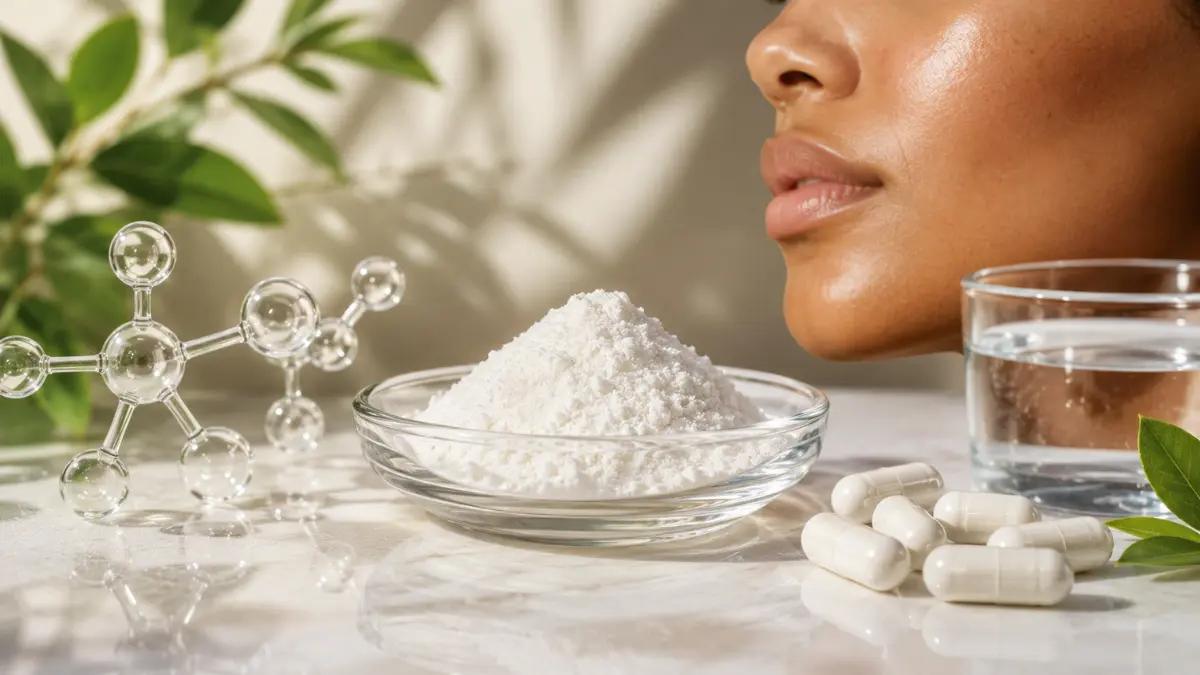
How to actually use L-glutathione powder
If you are formulating with raw L-glutathione powder, a few practical points matter more than the marketing.
- It is water-soluble. Dissolve it in the water phase of your formulation, not in oils.
- It oxidises. Glutathione is an antioxidant, which is another way of saying it sacrifices itself readily. Keep your formulation airtight, opaque, and cool, and make small batches you will finish.
- Typical topical use falls in the 1–2% range, in line with the concentration used in the split-face trial above.
- It pairs, rather than competes. Glutathione inhibits tyrosinase at one point in the pathway; ingredients like alpha arbutin and niacinamide act at different points. Layering mechanisms is generally more productive than doubling down on one.
If you want to build a brightening routine from scratch rather than assemble it by trial and error, our DIY Serums for Pigmentation & Brightening kit walks through the ratios and the pairings properly.
The Real L-Glutathione Benefits for Skin
Glutathione is a legitimate ingredient with a real mechanism and genuine evidence behind it across all three delivery routes except one: strong and clean topically, real but site-limited at a proper oral dose, and entirely unproven — with documented real risk — by injection.
It will not change your natural skin tone, and no honest formulator will tell you otherwise. What the research supports is a gradual reduction in excess pigment over a period of weeks to months, most cleanly demonstrated topically and also shown, at the right dose, orally — always as one part of a routine that also includes sun protection. Without daily sunscreen, you are inhibiting melanin production with one hand while stimulating it with the other.
The most reliable L-Glutathione benefits for skin come from consistent use inside a proper routine at a dose that’s actually been tested — whether that’s a topical serum or a correctly-dosed capsule like our own — not from a one-off drip or an underdosed, unproven supplement. If you would rather buy finished products than formulate, our Body Brightener targets pigment across the body, and you can browse the full Skincare range for face-focused brightening.
L-Glutathione Benefits for Skin: Frequently asked questions
Does L-glutathione powder really whiten skin?
It reduces excess melanin production gradually rather than “whitening” skin. The strongest evidence is for topical application — a 10-week split-face trial found a significant reduction in melanin index versus placebo. At a proper oral dose (500mg/day), a separate trial also found a significant reduction, though only at 2 of 6 body sites tested. No evidence supports injection.
How long does glutathione take to work on skin?
The clinical trials that found measurable effects ran for 4 to 12 weeks depending on the delivery method and dose. Expect to think in weeks to months, not days, and only alongside consistent sun protection.
Is oral or topical glutathione better for skin?
Topical has the cleanest evidence, thanks to split-face trial design. But oral glutathione at a proper dose — 500mg/day, matching our own capsule protocol — has shown a real, statistically significant effect in a controlled trial, not just a trend. Dose is what separates the oral studies that worked from the one that didn’t.
Is glutathione safe?
Oral and topical glutathione have good safety records in the published trials. Intravenous glutathione for skin lightening is a different matter entirely — regulators have warned against it, and reported harms include severe skin reactions and organ toxicity.
What percentage of glutathione should I use in a serum?
Around 1–2% in the water phase, matching the concentration used in the published split-face research. Keep it airtight and make small batches, because it oxidises readily.
L-Glutathione Benefits for Skin- The bottom Line
Glutathione earns a place in a brightening routine. It does not earn the promises made on its behalf. If you want to work with an ingredient that has real, evidence-backed effects at the right dose and delivery method — and you would rather be told the honest ceiling upfront than discover it three months and several thousand rand later — start with 99% pure L-Glutathione Powder and build from there.
Not sure where glutathione fits alongside everything else on your shelf? Our guide to the best skin brightening ingredients puts the whole category in order of evidence.
Want finished pigmentation skincare rather than raw actives? See our Pigmentation, Melasma & Chubaba solutions →
Melasma vs HyperpigmentationEpidermal vs Dermal — how deep?Why it's getting darkerHow long does it take to fade? How to remove ChubabaWhat to Use for HyperpigmentationTreatment for dark skinTreat melasma without hydroquinoneDoes microneedling help? Pigmentation, Melasma & Chubaba SolutionsFind your routine by concernChubaba Dark Patch CorrectorMelanin BreakerGuide: Why is it getting darker? Best Skin Brightening Ingredients10 actives compared · the hubAlpha Arbutin4-ButylresorcinolKojic Acid DipalmitateMulberry Root Extract NiacinamideVitamin C: SAP vs THDMix Vitamin C & Niacinamide?L-GlutathioneYou are hereTremella (hydration)Explore the pigmentation & melasma guide