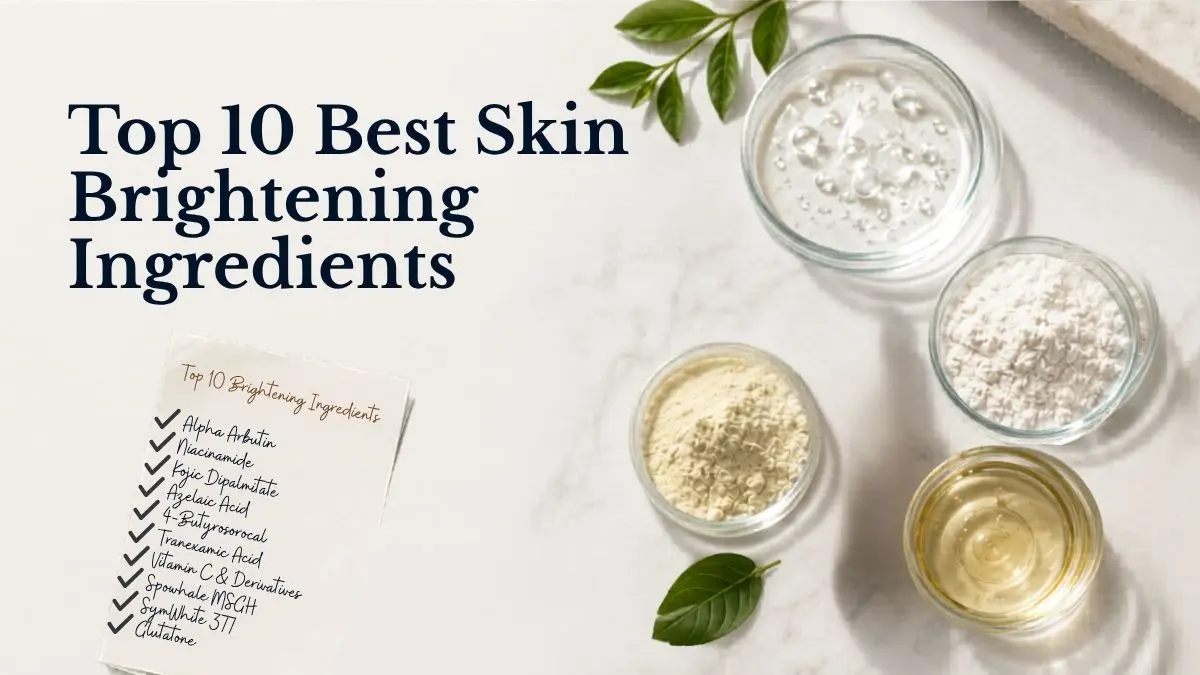
Best Skin Brightening Ingredients for Hyperpigmentation & Dark Spots
BEST SKIN BRIGHTENING INGREDIENTS · THE EVIDENCE
If you have hyperpigmentation, melasma, dark marks or Chubaba, you’ve probably wondered which skin-brightening ingredients actually work — and why an ingredient everyone raves about sometimes does absolutely nothing for your skin.
I went back to the research.
I looked at systematic reviews, randomized controlled trials and human studies behind some of the most popular ingredients for hyperpigmentation and dark spots. I also looked at study size, what form of the ingredient was actually tested and, where relevant, who funded the research.
Some ingredients have decades of evidence. Some newer actives look extremely promising. Others are much more famous on skincare labels than their human research would suggest.
But even excellent research cannot promise that an ingredient will work for you.
15 Best Skin Brightening Ingredients: What Does the Evidence Say?
One systematic review and meta-analysis of 45 studies involving 2,359 patients found hydroquinone, cysteamine, tranexamic acid, azelaic acid and kojic acid all improved melasma.
A separate review of 174 controlled trials gave hydroquinone, kojic acid and azelaic acid particularly strong recommendations, while calling for more research into several newer treatments.
So there isn’t one magical “best” ingredient.
| Ingredient | My evidence rating | What stood out |
|---|---|---|
| Hydroquinone | ★★★ Strong | Decades of human evidence |
| Azelaic Acid | ★★★ Strong | Multiple clinical trials |
| Tranexamic Acid | ★★★ Strong | Large and growing evidence base |
| Cysteamine | ★★★ Strong | Multiple randomized trials |
| Kojic Acid / KDP | ★★★ / ★★☆ | Kojic better studied; KDP attractive for formulation/tolerability |
| Thiamidol | ★★☆ Promising | Positive human studies; more independent research needed |
| 4-Butylresorcinol | ★★☆ Promising | Strong mechanism + positive human trials |
| SymWhite 377 | ★★☆ Promising | Impressive science; smaller clinical base |
| SepiWhite MSH | ★★☆ Promising | Positive human trial |
| Niacinamide | ★★☆ Worth trying | Different pigment-control mechanism |
| Alpha Arbutin | ★★☆ Promising | Popular; clinical evidence growing |
| Vitamin C | ★★☆ Worth trying | Form of Vitamin C matters |
| Retinoids | ★★★ Strong for right use | Particularly strong PIH evidence |
| AHAs | ★★☆ Useful | Exfoliation + superficial pigmentation |
| Botanicals | ★★☆ Promising | Evidence varies enormously by extract |
Important: showing that an ingredient inhibits tyrosinase in a laboratory is not the same as showing that it reduces pigmentation on real people’s skin.
How I Judged the Evidence
I didn’t rank an ingredient higher because it’s fashionable, because a supplier says it’s powerful or because I use it in a ShaRique Skin formula.
I looked first for systematic reviews and meta-analyses, then randomized trials and other human studies. I looked at how many people were studied, what ingredient and concentration they actually used and who funded the research where that information was relevant.
The stars aren’t a promise. They’re my assessment of how convincing the evidence currently looks.
NOT SURE WHAT TYPE OF PIGMENTATION YOU HAVE? READ OUR COMPLETE MELASMA & HYPERPIGMENTATION GUIDE →
ACTIVE 01 / 15
Tranexamic Acid: One of the Most Interesting Ingredients
A 2024 review of 22 randomized studies involving 1,280 people found tranexamic acid improved melasma. Oral treatment produced the strongest results, followed by injections and topical treatment.
Topical TXA is still interesting. Clinical research has found 5% topical tranexamic acid can produce improvements comparable with hydroquinone.
My take: There is enough evidence to make topical tranexamic acid well worth trying for stubborn pigmentation. Will it work for you? Nobody can promise that. Your skin gets the final vote.
Try it: Chubaba Dark Patch Corrector — 5% Tranexamic Acid + 4% Niacinamide + 2% Licorice Root.
ACTIVE 02 / 15
Azelaic Acid: Old Ingredient, Solid Evidence
In a double-blind study of 329 women, 20% azelaic acid produced good or excellent results in 65% of participants after 24 weeks, with no significant overall difference from 4% hydroquinone.
My take: Azelaic acid has earned its place among the better-studied ingredients for hyperpigmentation, particularly when pigmentation occurs alongside acne.
ACTIVE 03 / 15
Hydroquinone: It Works — But There Is a Catch
Hydroquinone remains one of the best-studied pigmentation treatments.
The evidence says it works.
But prolonged or inappropriate use can cause irritation and, more seriously, exogenous ochronosis — blue-grey or blue-black pigmentation. This is particularly relevant in South Africa, where ochronosis associated with skin-lightening products has been documented for decades.
My take: Hydroquinone works, but I wouldn’t treat it like an everyday brightening serum to use indefinitely. Professional guidance and a defined treatment period make sense.
ACTIVE 04 / 15
Cysteamine: The Research Caught My Attention
A 2024 systematic review and meta-analysis of randomized trials found 5% cysteamine improved melasma and did not show a significant efficacy difference compared with 4% hydroquinone.
My take: Cysteamine deserves to be taken seriously. The evidence isn’t as enormous as hydroquinone’s, but there is enough human research to make it worth investigating.
ACTIVE 05 / 15
Thiamidol: Promising — But Look at Who Did the Research
A 2024 systematic review identified 14 clinical studies, all reporting statistically significant improvements in hyperpigmentation.
Thiamidol is proprietary to Beiersdorf, and some important studies have involved or been funded by Beiersdorf. That doesn’t make the results wrong — but you deserve to know.
My take: Genuinely promising and worth trying. I’d like to see more large independent trials.
ACTIVE 06 / 15
4-Butylresorcinol: A Next-Generation Brightener
4-Butylresorcinol (4-BR) is one of the newer pigmentation ingredients I find particularly interesting.
In a randomized double-blind trial, 0.1% 4-BR significantly reduced melanin compared with the inactive base after eight weeks.
My take: 4-BR is a genuinely promising next-generation pigmentation ingredient. The science and human results are strong enough to explain why I chose to formulate with it.
VIEW MELANIN BREAKER — 4-BR + SYMWHITE 377 + TRANEXAMIC ACID →
ACTIVE 07 / 15
SymWhite 377: Impressive Science
SymWhite 377 is phenylethyl resorcinol, a potent tyrosinase inhibitor with promising laboratory and human evidence. Some clinical research uses it in combination formulas, which makes its individual contribution harder to measure.
My take: I rate SymWhite 377 highly and formulate with it myself. The science is impressive; I’d simply like to see more large independent trials of the ingredient alone.
ACTIVE 08 / 15
SepiWhite MSH: Interesting, But More Research Please
SepiWhite MSH is undecylenoyl phenylalanine. A randomized double-blind study involving 40 women found a 2% preparation significantly improved melasma compared with vehicle.
My take: Interesting and worth watching, but the clinical evidence base is still small.
ACTIVE 09 / 15
Kojic Acid & Kojic Acid Dipalmitate
Kojic acid has established human pigmentation research, but irritation and allergic contact dermatitis are recognised drawbacks.
Kojic Acid Dipalmitate (KDP) is the oil-soluble derivative I prefer to formulate with. Its formulation characteristics and tolerability make it particularly interesting where avoiding irritation matters — especially in skin of colour, where inflammation can leave further pigmentation.
Kojic acid still has the larger direct clinical evidence base, so I wouldn’t claim that KDP has been conclusively proven more effective.
ACTIVE 10 / 15
Alpha Arbutin: Popular for a Reason
A 2025 randomized pilot study tested 5% alpha arbutin + 2% kojic acid against prescription triple-combination treatment in 30 people with melasma. Important pigmentation measurements did not differ significantly between treatments, although it was a small combination study.
My take: I like alpha arbutin and formulate with it. It becomes particularly interesting when combined intelligently with other actives.
ACTIVE 11 / 15
Niacinamide: More Than a Supporting Ingredient
In a randomized split-face study, 27 people with melasma used 4% niacinamide on one side and 4% hydroquinone on the other. Both improved, while adverse effects were lower with niacinamide.
Niacinamide is also interesting because it can reduce pigment transfer rather than simply targeting tyrosinase.
My take: Niacinamide isn’t filler. Its different mechanism is exactly why I like it in multi-active pigmentation formulas.
ACTIVE 12 / 15
Vitamin C: Which Vitamin C?
Vitamin C has pigmentation evidence, but the form matters. We shouldn’t assume research on L-ascorbic acid automatically proves SAP, THD Ascorbate and every other derivative perform identically.
My take: Vitamin C remains valuable for pigmentation and antioxidant support, particularly alongside complementary actives.
ACTIVE 13 / 15
Retinoids: They’re Not All the Same
Tretinoin has particularly strong pigmentation evidence. A 40-week randomized study involving 54 Black patients found significantly greater improvement in post-inflammatory hyperpigmentation with tretinoin than vehicle.
Retinol also has human evidence, while research around HPR (Hydroxypinacolone Retinoate) is developing. Retinyl palmitate has been studied more often in cosmetic combinations.
My take: I wouldn’t dismiss cosmetic retinoids simply because tretinoin has stronger evidence. We formulate with HPR in our Retinol Smoothing & Firming Face Cream.
ACTIVE 14 / 15
Mandelic Acid & Other AHAs
A randomized study of 90 Indian patients found salicylic-mandelic peels produced melasma improvement comparable with glycolic acid and were better tolerated.
My take: Particularly in skin of colour, stronger isn’t automatically better. Avoiding unnecessary inflammation matters.
ACTIVE 15 / 15
Botanical Brighteners: Don’t Dismiss Them
Mulberry has direct human evidence. In a randomized placebo-controlled study of 50 people, mulberry extract significantly improved melasma after eight weeks.
Licorice also has interesting pigmentation research, while multi-botanical complexes such as Gigawhite offer another formulation approach. Evidence varies depending on the actual extract and finished formula.
My take: Botanicals shouldn’t get a free pass because they’re “natural,” but they shouldn’t be dismissed either.
FOR FORMULATORS:
SHOP LICORICE ROOT → SHOP MULBERRY → SHOP GIGAWHITE →
Best Skin Brightening Ingredients: Which Should You Try?
Melasma or stubborn pigmentation: Tranexamic acid, azelaic acid, hydroquinone, cysteamine and 4-BR are all worth investigating.
Dark marks after acne: Tranexamic acid, azelaic acid, retinoids and niacinamide are particularly interesting.
Sensitive or easily irritated skin: Don’t assume stronger is better. Niacinamide, alpha arbutin and carefully formulated botanical brighteners may be worth exploring.
Nothing seems to work: Combination formulas become interesting because different ingredients can target pigmentation through different pathways.
Whatever you choose, don’t ignore sun protection.
Why Can a Good Ingredient Still Fail?
Because pigmentation isn’t one condition.
Melasma, post-acne marks, sun-induced pigmentation and deeper pigmentation don’t necessarily respond in the same way. Concentration, ingredient form, finished formulation, consistency and your skin’s tolerance all matter.
And irritation matters. Particularly in skin of colour, repeatedly inflaming the skin can contribute to further post-inflammatory pigmentation.
The studies help us decide what’s worth trying. Your skin gives us the final answer.
Want to Choose the Actives in Your Own Formula?
That’s one reason ShaRique Skin also offers custom skincare formulation.
If you’ve already discovered which actives your skin likes — or this investigation has helped you identify ingredients you’d like to try — you can tell us which cosmetic actives you’re interested in.
We’ll consider your skin concerns, the ingredients you’ve selected and whether they can appropriately be combined into a balanced cosmetic formulation.
Instead of simply accepting whatever combination is already sitting on a shelf, you have a say in the actives we formulate with.
Where to Go Next
Want a ready-made treatment?
Explore Pigmentation, Melasma & Chubaba Solutions →
Want the raw ingredients?
Shop Skin-Brightening Ingredients →
Still trying to understand your pigmentation?
Read the Complete Melasma & Hyperpigmentation Guide →
Want to formulate your own pigmentation serums?
Explore DIY Serums for Pigmentation & Brightening →