
4-Butylresorcinol: Why This Potent Pigmentation Active Shines
4-Butylresorcinol is not a new ingredient. But if you ask most people what it is, you will get a blank stare, despite it being one of the most potent tyrosinase inhibitors available in cosmetic skincare today.
As a skincare formulator, I have worked extensively with Alpha Arbutin, Kojic Acid, Niacinamide, Tranexamic Acid, and most of the brightening agents commonly used in hyperpigmentation formulations. And I am saying this based on formulation experience: 4-Butylresorcinol performs differently compared to many conventional brightening agents. Research suggests 4-Butylresorcinol demonstrates significantly stronger tyrosinase inhibitory activity than commonly used agents such as kojic acid and arbutin in in-vitro studies. That is a strong laboratory result, but laboratory enzyme potency and clinical treatment superiority are not the same thing; human studies separately show it can improve melasma and other hyperpigmentation.
If you are a formulator and want to work with 4-nBR yourself, you can find the raw ingredient Here.
Want 4-Butylresorcinol already formulated for you? See Melanin Breaker →
Table of Contents
My Journey with 4-Butylresorcinol
When I first began my formulation journey, many years ago, I purchased the raw material based on the supplier’s description. I used it as a standalone active and was not too impressed. Because the industry hype was heavily concentrated on Alpha Arbutin, Kojic Acid, and Niacinamide, I was initially swept up in that trend and did not focus too much on 4-Butylresorcinol.
Then a few years ago, a person suffering from pigmentation approached me for help. She had damaged her skin through the use of skin lighteners and said she had tried everything on the market, but nothing was working. In clinical reality, cases like this are complex, and there is no guarantee that pigmentation of this nature will fully resolve.
To help her, I began deep-diving into the best skin brightening ingredients and came across 4-Butylresorcinol again. My research showed it demonstrated stronger tyrosinase inhibitory activity than many standard brightening ingredients on the market. To cut a long story short, I created a formula for her using a triad of high-performance brighteners: 4-Butylresorcinol, SymWhite 377, and Tranexamic Acid, balanced with ceramides and other key actives for barrier support and repair.
I had to be extremely careful. Working with skin of colour in a high UV index environment means melasma and pigmentation are often highly reactive. My goal was to avoid triggering post-inflammatory pigmentation at all costs.
I tested the product I created on myself because I suffer from pigmentation. I know the cycle well. My skin can be clear for months, only for a day at the beach to cause hyperpigmentation to resurface. For me, that pigment can take months to fade.
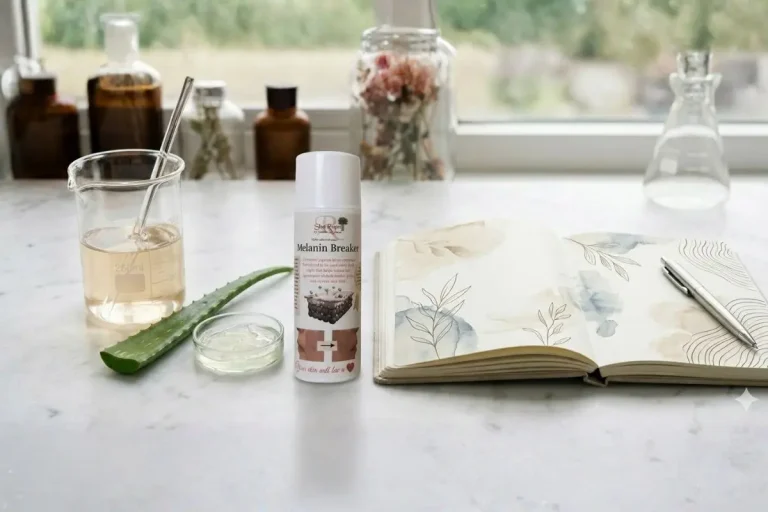
When it came to the pigmentation sufferer, she herself admitted she had damaged her skin with skin lighteners, so I didn’t expect to hear from her again, as she was the type of person who uses product after product hoping for miracles. But after a month, she messaged me: “Guess what? I see a difference in my skin.” I was not surprised because I used the product, which I subsequently named Melanin Breaker, on myself and saw a difference in my own hyperpigmentation, which is why I developed the lightweight moisturiser.
Find out more about Melanin Breaker here.
What Is Actually Happening in Your Skin
To understand why 4-Butylresorcinol matters, it helps to understand what is happening when a dark spot forms, and why most products fail to stop it.
Your skin produces melanin to protect itself from UV radiation. Under normal conditions, that process is controlled and regulated. But in cases of melasma or post-inflammatory hyperpigmentation (PIH), something goes wrong and the production line gets stuck in overdrive. The driver of that process is an enzyme called tyrosinase. It acts as the main switch. When it is activated, your skin starts converting amino acids into dark pigment. UV exposure, hormonal shifts, and inflammation from skin damage are the most common triggers.
Most brightening ingredients try to interfere with this process at various points in the chain. What makes 4-Butylresorcinol notable is its direct action on tyrosinase and related enzymes involved in melanin production, which are key control points in the pigmentation process. It also inhibits a second enzyme called TRP-1, which adds another layer of pigment suppression most brighteners simply cannot offer.

4-Butylresorcinol is a resorcinol derivative that inhibits two enzymes involved in melanogenesis: tyrosinase and tyrosinase-related protein-1 (TRP-1). This dual enzyme activity is one of the reasons it is such an interesting pigmentation active.
What the Clinical Evidence Shows—and Why 4-Butylresorcinol Matters for South African Skin
For South African consumers, I pay particular attention to evidence from melanin-rich skin because post-inflammatory hyperpigmentation and melasma are major concerns in darker skin tones. Local UV exposure also makes daily photoprotection an essential part of any pigmentation routine.
This is why a specific Indian clinical study changed how I think about 4-Butylresorcinol entirely.
The study evaluated 4-n-Butylresorcinol 0.3% cream in 52 people with melasma. Melasma severity fell substantially over eight weeks and the treatment was generally well tolerated. For me, the relevance is that this gives us clinical data in an Indian population rather than relying only on laboratory testing.
If you have spent any time managing pigmentation in South Africa, you will understand why that last part matters just as much as the first. We do not live in mild climates with controlled sun exposure. In pigmentation-prone skin, significant irritation can trigger post-inflammatory hyperpigmentation and set treatment progress back. That is why tolerability matters alongside potency. An ingredient that can reduce melasma severity by more than 50% while being generally well tolerated in that study population is not a small thing. For many people, it may be exactly what has been missing.
If you want to understand why your melasma or dark spots may be getting worse rather than better, download Why is My Melasma or Dark Spots Getting Darker?
A South African Problem That Deserves a South African Answer
Here is a number worth sitting with, a large majority of South Africa’s population over 90 % falls into skin of colour categories, including Black African, Coloured, and Indian/Asian communities combined. This is not a niche demographic. This is the majority.
And yet the pigmentation products commonly available in retail markets have historically been developed and tested on lighter skin tones, in climates nothing like ours, for concerns that do not fully reflect what darker skin actually experiences.
This matters because skin of colour responds to pigmentation differently. Dark spots show up more visibly and fade more slowly, and this is the part that exhausts so many people, the wrong product can potentially make things worse. In melanin-rich skin, irritation and inflammation can leave persistent post-inflammatory hyperpigmentation. This makes treatment tolerability particularly important when choosing strong pigmentation actives. Post-inflammatory hyperpigmentation is one of the most persistent skincare concerns for South Africans with darker skin tones, and it is one of the hardest to treat without the right approach.
If you have been through that cycle, cleared your skin, had one bad sun day, watched months of progress disappear, you know exactly how defeating that feels.
4-Butylresorcinol’s track record in skin of colour, combined with its tolerability in high UV environments, is precisely why it is well suited for inclusion in pigmentation-focused formulations designed for this market. Not as a trend. As the foundation.
Why Most South African Products Still Don’t Use It
4-Butylresorcinol is still less familiar to consumers than ingredients such as Vitamin C, Niacinamide and Alpha Arbutin, despite having strong laboratory activity and human clinical evidence.
Formulating with it responsibly adds further complexity. It requires the correct pH range to remain stable, protective supporting ingredients to prevent degradation, and packaging that limits exposure to air and light. A skilled formulator accounts for all of this, but it adds time, expertise, and real cost to the process.
However, and this is important, it does not automatically make the product effective. Performance still depends on the full formula: the concentration used, stability of the active, supporting ingredients, pH, packaging, and how the product is positioned within a broader pigmentation strategy. In other words, the ingredient is a strong signal of formulation intent, not a guarantee of results.

Why I Prefer a Multi-Ingredient Approach for Stubborn Pigmentation
4-Butylresorcinol can work as a stand-alone active — vehicle-controlled clinical trials have demonstrated that. In my own formulations for stubborn pigmentation, I prefer combining complementary actives so the formula can address more than one part of the pigmentation process.
The most effective strategy is to target the pigmentation process from multiple angles simultaneously, reducing the skin’s ability to route around any single intervention.
This is the thinking behind Melanin Breaker, the pigmentation moisturiser I formulated specifically with skin of colour in mind. It pairs 4-Butylresorcinol with Tranexamic Acid, which works upstream in the process by interrupting the skin’s initial signal to produce more pigment, and SymWhite 377, which adds a further layer of melanin suppression while providing antioxidant protection.
Three ingredients. Three different intervention points. Fewer opportunities for the skin to compensate. That is what a considered formulation strategy looks like in practice.
Want to compare 4-Butylresorcinol with other brighteners? Best Skin Brightening Ingredients: 10 Potent Actives Compared →
Click HERE if you curious about Melanin Breaker
One More Thing Worth Reading
If you want to go deeper into melasma specifically, what drives it, why it is so reactive, and what actually works long-term for skin of colour in South Africa, I have written a full guide on that Melasma and Hyperpigmentation: Causes, Treatments, and How to Fade Dark Patches
This article is based on personal formulation experience and interpretation of published cosmetic science research. Individual results will vary depending on skin type, environment, consistency of use, and other factors. Nothing in this article constitutes medical advice. Consistent sun protection is a non-negotiable part of any pigmentation management approach.
Explore the pigmentation & melasma guide
Melasma vs HyperpigmentationEpidermal vs Dermal — how deep?Why it's getting darkerHow long does it take to fade?
How to remove ChubabaWhat to Use for HyperpigmentationTreatment for dark skinTreat melasma without hydroquinoneDoes microneedling help?
Pigmentation, Melasma & Chubaba SolutionsFind your routine by concernChubaba Dark Patch CorrectorMelanin BreakerGuide: Why is it getting darker?
Best Skin Brightening Ingredients10 actives compared · the hubAlpha Arbutin4-ButylresorcinolYou are hereKojic Acid DipalmitateMulberry Root Extract