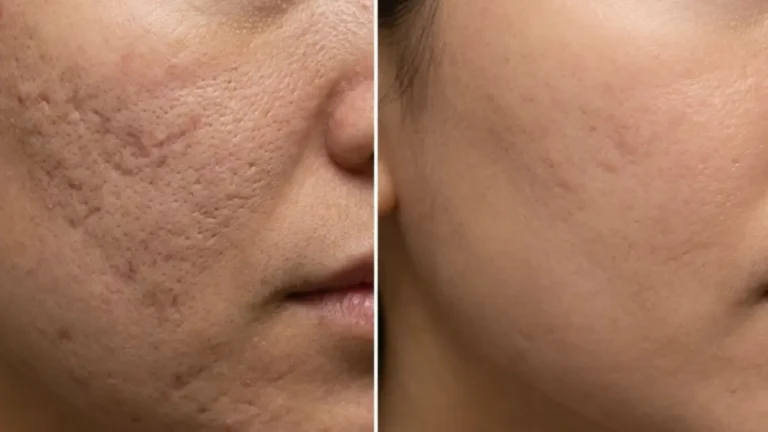

Hyperpigmentation Treatment for Dark Skin
Hyperpigmentation treatment needs extra care in darker skin tones. Many of the same pigment treatments can be used across skin tones, but darker skin contains more melanin and is more prone to post-inflammatory hyperpigmentation, which means irritation from the treatment itself can sometimes leave additional dark marks.
Our pick for stubborn pigmentation: the Melanin Breaker — a high-potency formula with 4-Butylresorcinol, Tranexamic Acid and SymWhite® 377 to help fade melasma and dark marks.
Your environment can also affect how you manage pigmentation. In South Africa, strong sun exposure makes consistent photoprotection particularly important. Heat, humidity and sweating can also affect how comfortable your routine feels and how well your skin tolerates certain products.
If you want to find out why your hyperpigmentation is refusing to budge, or why it seems to get worse no matter what you do, download Why Is My Dark Spots & Melasma Getting Darker? This blueprint discusses the hidden role of inflammation, how your skin barrier dictates your recovery, and how to truly understand your own skin biology.
Ready to treat the pigmentation itself? Build your Pigmentation, Melasma & Chubaba routine according to your budget and goals →
Most people are looking for a quick fix or asking “what works to remove dark spots,” but there is no single ingredient or product that will do the trick. When it comes to hyperpigmentation treatment for dark skin, you need to understand your unique skin biology, which is exactly what we will delve into here.
Table of Contents
What to Avoid in Hyperpigmentation Treatment for Dark Skin
If you are dealing with dark spots, melasma, or post-acne marks, the goal is not to reach for the strongest or most “potent” product. That was something I believed at one point too. Before I understood how reactive skin of color can be, I assumed more strength meant better results and a faster outcome.
I used to watch YouTube videos of people using exfoliants every night, talking about how amazing it was while showing off their glowing skin. I tried to do the same. Within just three nights, my skin became completely dry, dull, and started stinging. No one ever told me about the skin barrier back then.
So let me tell you what you should NOT do, so you can immediately recognize if you’re going in the wrong direction. I’ve experienced these mistakes firsthand. I’m not speaking from textbooks or theory; I’m speaking from real skin experience.
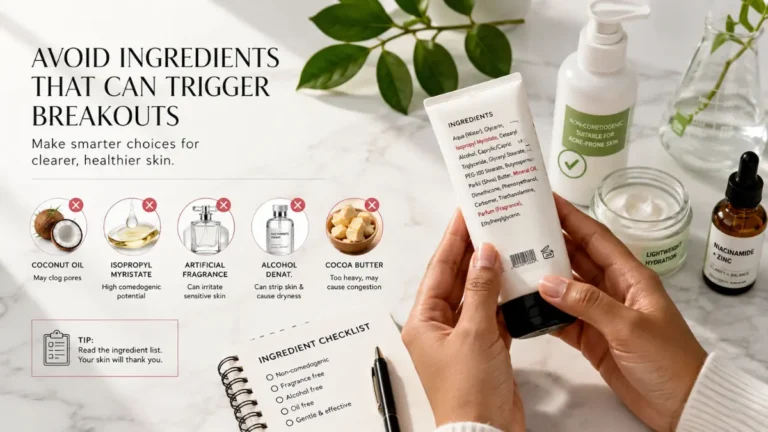
Avoid these triggers to protect your skin barrier:
- Harsh scrubs that cause irritation and inflammation.
- Over-exfoliating — how often you exfoliate depends on the exfoliant, its strength and how well your skin tolerates it.
- Constantly switching products before your skin has had time to adjust.
- Anything that leaves the skin irritated, “hot,” or stinging.
- Alcohol-heavy products if they leave your skin dry, tight or irritated — choose a gentler alternative.
- Fragrance and essential oils if they irritate your skin; if you notice stinging, redness or repeated reactions, avoid the product, because ongoing irritation can contribute to post-inflammatory pigmentation.
- Products that repeatedly sting or leave your skin red, since ongoing irritation can contribute to dark marks.
- Very hot facial steaming if heat consistently makes your skin flush or look darker — though ordinary cooking heat is not equivalent to UV from the sun.
- Sunlight remains the main pigmentation trigger, much more than ordinary household heat.
- Prolonged unprotected sun exposure, particularly when UV levels are high.
- Skipping sunscreen on cloudy days, because UV and visible light still drive pigmentation even when the sun isn’t visibly shining.
- Picking or squeezing pimples, which increases inflammation and can increase the risk of post-inflammatory dark marks.
- Using too many active ingredients at the same time, which frequently leads to barrier damage and rebound pigmentation.

What Works in Hyperpigmentation Treatment for Dark Skin
Hyperpigmentation treatment in dark skin is not a random mix of products. It is a structured system where each step has a purpose, and the order determines the outcome. If you get the order wrong, you don’t get results, you get irritation, and irritation can lead to more pigmentation.
1. Cleanse (Reset without damage)
A cleanser does not directly treat hyperpigmentation. Its main job is to:
- Remove dirt, oil, sweat, and sunscreen.
- Clear pollution and buildup from the skin surface.
- Prepare the skin for the active products that follow in your routine.
Think of it as a reset step, not a treatment step. However, even though it does not treat pigmentation directly, it still plays a vital role in your skincare routine. If a cleanser is too harsh, it can damage the skin barrier. When the barrier is disrupted, the skin becomes reactive. This irritation triggers inflammation, which is one of the key drivers of pigmentation in darker skin tones.
What Cleanser to Use
When choosing a cleanser for hyperpigmentation-prone skin, look for words that signal gentle, barrier-friendly formulas. These usually indicate the product cleans without stripping your natural lipids:
- Gentle cleanser
- Hydrating cleanser
- Cream cleanser
- Milky cleanser
- Low-foam / non-foaming
- Sulfate-free
- pH-balanced
- Barrier-supporting
- For sensitive skin
Some great options in South Africa include the following
Oats, Honey, Rose Water Gentle Cleanser, : This is made from natural ingredients and surfactants
Salicylic Acid Cleanser (2%) | Professional Strength: This deep cleans the pores with Salicylic Acid using non-stripping surfactants.
Pigmentation Cleanser: Another fantastic choice, which also contains niacinamide
2. Protect SPF 50 + (Prevent new pigmentation before it starts)
This is the most overlooked step, yet it is the most critical phase of hyperpigmentation control. Without good photoprotection, you can undermine the progress you are trying to make with your pigment treatments.
Daily protection must include:
- Consistent sunscreen use: Apply daily, even on cloudy days, and reapply every 2 to 3 hours if you are outdoors.
- Broad-spectrum coverage: use a broad-spectrum sunscreen for UVA and UVB. For melasma or persistent pigmentation in darker skin, a tinted sunscreen with iron oxides adds visible-light protection.
- Heat awareness: if heat consistently worsens your pigmentation, limit prolonged heat exposure such as very hot steaming — though sunlight remains the main trigger.
UV and visible-light exposure can stimulate pigmentation, and repeated irritation and inflammation can also contribute to new dark marks. If this protective step is missing, your pigmentation can be constantly re-triggered, stalling your progress.
3. Calm (Stop the inflammation cycle)
Before aggressively treating pigment, you must calm the skin. Inflammation is not always dramatic or easy to see. Mild ongoing irritation can still contribute to post-inflammatory pigmentation, particularly if your skin repeatedly stings, burns, peels or reacts to products. Inflammatory signals can encourage melanocytes — the cells that produce melanin — to produce more pigment; think of it as keeping the pigment response switched on.
This calming phase focuses on:
- Reducing sensitivity: Lowering the skin’s overall reactivity.
- Soothing reactive skin: Quieting the pathways that trigger melanin.
- Preventing irritation cycles: Breaking the loop of chronic, low-grade inflammation.
A calm skin state is the foundation of your recovery; it is what allows hyperpigmentation to finally stop spreading.
Do you need one product or multiple products for calming inflammation?
Calming inflammation does not have to come from a single product. In fact, many modern skincare products already include anti-inflammatory ingredients built into their formulas, supporting the skin while simultaneously cleansing, hydrating, or treating. However, this is not always enough.
While a well-formulated, multi-functional product provides a baseline level of inflammation control, the skin may still need extra targeted support, especially if it is reactive, sensitized, or already locked in a pigmentation cycle. From my experience formulating with different ingredient combinations, I’ve found that using a separate, dedicated inflammation-support step can be far more effective than relying only on all-in-one products. This step could be a toner, a serum, or even a lightweight calming essence depending on your routine. It allows you to actively focus on reducing irritation without overloading the skin with too many competing active ingredients.
Calming inflammation is not just about “soothing the skin surface”; it is about switching off the internal signals that keep melanocytes producing excess pigment. When inflammation is controlled, every subsequent step in your routine works better and more consistently.
Ingredients that help calm inflammation in Hyperpigmentation Treatment for Dark Skin
When looking for calming support, focus on ingredients that reduce reactivity and assist with barrier recovery. While there are many options, these are a few examples:
- Panthenol (Pro-Vitamin B5)
- Allantoin
- Centella Asiatica (Cica)
- Beta-glucan
- Madecassoside
- Aloe Vera (in stable, non-irritating formulations)
- Green tea extract
- Licorice root extract (dual calming + brightening effect)
These ingredients work together to reduce redness, support skin repair, and lower the overall inflammatory response that drives pigmentation. In hyperpigmentation treatment, calming the skin is not a temporary phase, it is an ongoing requirement. Because low-grade inflammation is often invisible, your melanocytes can remain active and produce pigment in the background even when your skin looks completely fine.
To understand exactly how inflammation sabotages your results, read my investigative report: Why Your Melasma or Dark Spots are Getting Darker.
4. Treat (Regulate melanin production)
You can’t effectively treat hyperpigmentation when the skin is still inflamed, so recognizing when your skin has calmed down is important before introducing or continuing active ingredients. Once the skin is stable, you can begin actively treating hyperpigmentation. This is not about bleaching the skin; it is about controlling how much pigment is produced and transferred. This is where targeted ingredients work gradually to regulate melanocyte activity and reduce uneven tone over time.
The key here is consistency, not intensity. Dark skin responds better to steady regulation than aggressive correction. If your skin is still reacting to “basic care,” it is not ready for actives. But if your skin feels calm and stable, then you can slowly reintroduce treatment products without triggering new inflammation.
Hyperpigmentation treatment for dark skin comes in serums, moisturizers, facial oils, toners, and spot treatments. Now, when should you use these products? There is an ongoing debate in the industry. Some skin experts claim you can use highly volatile actives in the daytime as long as you apply a broad-spectrum sunscreen. Others say avoid them entirely.
Ultimately, the choice is yours. Whether a pigment treatment is used in the morning or at night depends on the ingredient and the formulation. Do not assume that every brightening ingredient becomes dangerous in daylight. Follow the product directions and use daily sunscreen. If your routine contains several potentially irritating actives, separating them between morning and evening can make the routine easier for your skin to tolerate.
My preference is not to hammer already reactive skin with multiple strong actives morning and night. If your night routine is doing the heavy treatment work, your morning routine can stay simpler: hydration, barrier support and sunscreen.
We have all seen social media influencers pile on everything, layering five different steps in a single morning. But you are reading this article because you want to make informed decisions. Instead of overloading your skin with too many active products, it is better to simplify. Rather stick to a dedicated night serum and a moisturizer with tyrosinase inhibitors, or just use one high-performance product.
In doing this, you must consider your skin barrier as well. If your pigment correctors don’t provide barrier support, you are moving backward. Look for formulations that combine pigment-targeting ingredients with barrier-supporting ingredients such as ceramides, panthenol or other soothing ingredients.
Want a more advanced pigment corrector that targets pigmentation while also supporting the skin barrier? See Melanin Breaker.
And how often should you use these actives?
That depends entirely on your own skin. This is why it is so incredibly important to learn and understand your skin. While your friend can handle using a heavy pigment corrector every single night, you may only be able to handle it by using it every second day, every third day, or perhaps for three days in a row followed by a break.
I really don’t believe in a “one-size-fits-all” skincare routine. From looking at my own skin’s behavior to the intensive interviews I have conducted with people with skin of color, the ultimate truth is this: there is no rigid rulebook. When it comes to choosing how many actives you should use, this is where it gets hard. More brightening ingredients do not automatically mean better results. What matters is whether the ingredients are well chosen, properly formulated and tolerated by your skin. Using too many at once can also cause irritation. Rather, use your product and assess your skin. You might find that a potent tyrosinase-inhibiting product works for you, but you can only use it every second or third night. Again, I emphasize: learn your skin, and put the power back in your hands.
Ingredients to look for in Hyperpigmentation Treatment for Dark Skin
- 4-Butylresorcinol
- Niacinamide (Vitamin B3)
- Tranexamic Acid
- Kojic Dipalmitate (instead of kojic acid, as it is less irritating)
For an in-depth look at more skin-brightening ingredients, read: Best Skin Brightening Ingredients
The Retinoid Family
Retinoids are a group of Vitamin A derivatives that help increase skin cell turnover, regulate pigmentation, and improve uneven skin tone over time. They are one of the most effective ingredient groups in hyperpigmentation treatment, but they vary in strength and irritation potential.
Understanding the retinoid family is important because, in dark skin, the goal is always results without triggering inflammation.
To delve deeper into retinoids, the types and what is best for you Read What do retinoids do?
5. Repair (Strengthen the barrier for long-term stability)
The skin barrier is your ultimate defense system. When it is weak, everything becomes reactive; skincare actives, environmental heat, friction, and even otherwise mild ingredients can easily trigger new pigmentation.
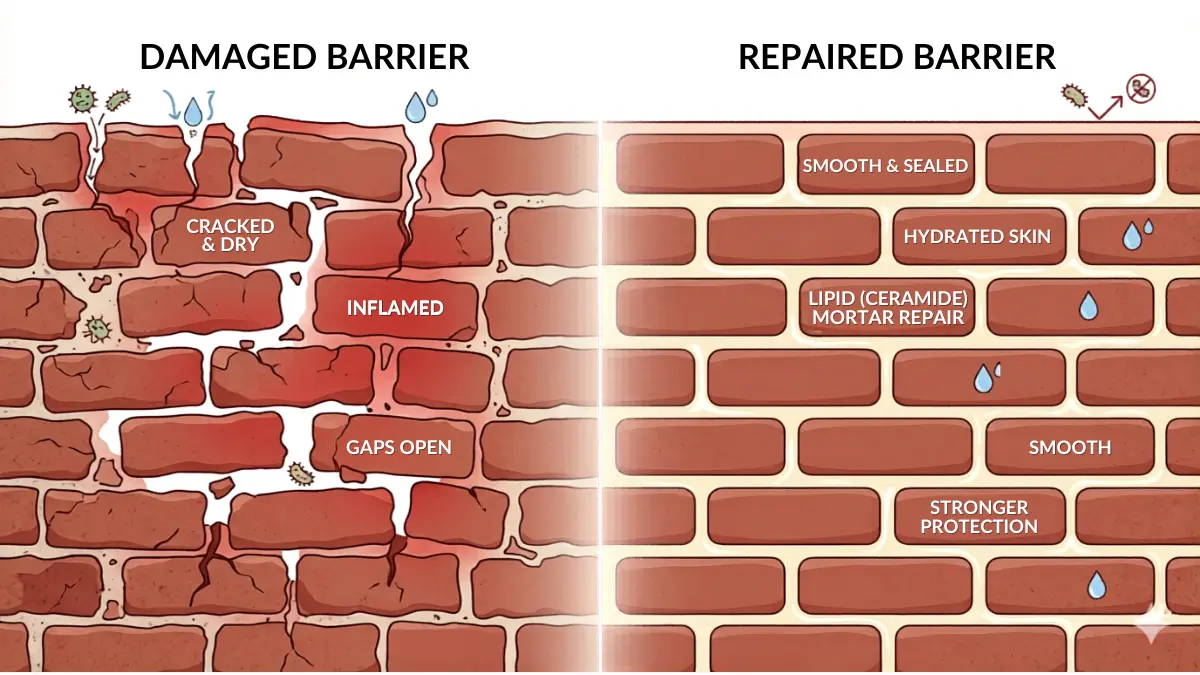
Repair focuses on:
- restoring barrier integrity
- reducing transepidermal water loss (TEWL)
- improving tolerance to active ingredients
A strong barrier makes your treatment results far more stable and significantly reduces the risk of a relapse. This is why a high-quality barrier repair cream is essential, ideally one containing ceramides, like the ShaRique Skin Barrier Repair Cream. Ceramides are lipids naturally found in the skin that help rebuild the “mortar” between your skin cells, sealing the barrier shut. In skin of color, maintaining this barrier function is especially critical because low-grade irritation can quickly cascade into stubborn post-inflammatory hyperpigmentation.
Look for barrier-supporting ingredients such as:
- Ceramides
- Cholesterol
- Fatty acids
- Panthenol (Pro-Vitamin B5)
- Squalane
- Beta-glucan
You can use a barrier repair cream, both in the morning and at night, or whenever your skin feels sensitive, reactive, or overworked. For skin that is dry, sensitive or using potentially irritating actives, a dedicated barrier-supporting moisturiser can be an important part of the routine.
6. Controlled Exfoliation (Support renewal, not damage)
Exfoliation is not a daily process in hyperpigmentation treatment; it is a controlled support step. Its purpose is to gently encourage the removal of pigmented surface cells without causing underlying inflammation. Over-exfoliation does the exact opposite, it damages the protective barrier and triggers melanocytes to produce more pigment. The rule is simple: support natural renewal, never force it.
There are different types of chemical exfoliants, and they work in distinct ways. They work by loosening the bonds between dead skin cells so they can shed more evenly.
- AHAs (like Glycolic, Mandelic and Lactic Acid): Focus on surface-level exfoliation and visible brightness.
- BHAs (like Salicylic Acid): Oil-soluble molecules that penetrate deeper into the pores to help with congestion.
- PHAs (like Gluconolactone): Larger-sized molecules that exfoliate slowly at the very surface, making them far better tolerated by sensitive or reactive skin.
For managing hyperpigmentation in dark skin, the safest chemical exfoliants are Lactic Acid, Mandelic Acid, and PHAs, because they are unlikely to cause a chemical burn or trigger post-inflammatory hyperpigmentation. Start conservatively and follow the directions for the specific product. Do not increase frequency simply because your skin has not peeled — visible peeling is not required for an exfoliant to work.
If you want to find out more about exfoliants and discover which one is right for your unique skin profile, read my comprehensive guide Chemical Exfoliation – All You Need to Know.
7. Maintenance (Prevent recurrence)
Once pigmentation starts improving, the focus shifts from active correction to long-term maintenance. This is where people can easily lose progress: pigmentation starts improving, so treatment and sun protection are stopped too soon. A proper maintenance phase includes:
- Continued sun protection: Maintaining rigorous UV defense to prevent melanocyte reactivation.
- Low-level pigment control ingredients: Switching to gentle, long-term brighteners that keep pigment production quiet without stressing the skin.
- Avoiding irritation triggers: Sidestepping known inflammatory catalysts like aggressive friction, heat, or volatile products.
- Maintaining a stable routine: Keeping the skin barrier balanced and predictable.
Some dark marks resolve completely, while conditions such as melasma can recur. If the original trigger keeps returning — acne, irritation, sun exposure or inflammation — new pigmentation can form. Maintenance helps protect your progress and reduce the chance of pigmentation returning, but permanent clearance cannot be guaranteed.
The Core Principle in Hyperpigmentation Treatment for Dark Skin
Hyperpigmentation in dark skin improves when you
Clean → Protect → Calm → Treat → Repair → Renew → Maintain
When this structural system is respected, the skin stops reacting and starts correcting itself naturally over time. Clinical research supports two important principles behind this routine: control the cause of inflammation where possible, and avoid creating additional irritation while treating the pigment. A 2024 systematic review examined 48 studies involving 1,356 people with skin of colour. Most cases in the included studies followed inflammatory conditions, and the review confirmed that PIH can be persistent and difficult to treat. It also found that treatment results vary and that no single treatment works reliably for everyone.
The review also highlighted that treatment outcomes vary wildly, proving that no single approach works consistently for everyone. While combination approaches, such as combining topical agents, retinoids, chemical peels, and laser treatments, showed partial improvement, the results remain unpredictable. The truth is that your routine must be tailored entirely to your individual skin type, focusing on calming the inflammation pathway before all else.
Ready to build your pigmentation routine? You do not need every product on this page — start according to your skin, your budget and how much support you want.
Start simple → Chubaba Dark Patch Corrector
Go advanced → Melanin Breaker
Build the full routine → Pigmentation, Melasma & Chubaba Solutions
Explore the pigmentation & melasma guide
Melasma vs HyperpigmentationEpidermal vs Dermal — how deep?Why it's getting darkerHow long does it take to fade?
How to remove ChubabaWhat to Use for HyperpigmentationTreatment for dark skinYou are hereTreat melasma without hydroquinoneDoes microneedling help?
Pigmentation, Melasma & Chubaba SolutionsFind your routine by concernChubaba Dark Patch CorrectorMelanin BreakerGuide: Why is it getting darker?
Best Skin Brightening Ingredients10 actives compared · the hubAlpha Arbutin4-ButylresorcinolKojic Acid DipalmitateMulberry Root Extract