Sodium Ascorbyl Phosphate vs Tetrahexyldecyl Ascorbate: Which Vitamin C Fades Dark Spots?
Sodium ascorbyl phosphate and tetrahexyldecyl ascorbate are both sold as “vitamin C”, and they behave so differently on skin that treating them as interchangeable is the reason most people’s vitamin C serum disappoints them. One is water-loving and works best on oily, breakout-prone skin. The other is oil-loving and suits dry or ageing skin and oil-phase formulas. Neither is a weaker version of the other. Both are vitamin C derivatives used for antioxidant and brightening purposes, but their evidence bases are not identical. Vitamin C can reduce melanogenesis, while the amount of direct clinical evidence for individual derivatives such as SAP and THD varies.
The confusion is not your fault. The label says vitamin C. The bottle says vitamin C. Nobody explains that “vitamin C” on an ingredients list is a category, not an ingredient — roughly as specific as writing “meat” on a menu.
Pure vitamin C, L-ascorbic acid
This is the form with the deepest research base. It is also, from a formulator’s perspective, a nightmare to formulate with. L-ascorbic acid is hydrophilic, meaning it loves water and repels oil. Unfortunately your stratum corneum (the outermost layer of skin) is essentially a lipid barrier, an oily wall designed to keep water-loving things out. It works. Your skin repels L-ascorbic acid rather effectively.
The only way through is to drop the pH below about 3.5, which strips the molecule of its charge and lets it slip past the barrier. That is why serious L-ascorbic acid serums are formulated so acidic, and why they sting. It is also why they turn orange-brown in the bottle within weeks — L-ascorbic acid oxidises on contact with air, light and water, and once it has browned, it has degraded.
When it comes to skin brightening and fading hyperpigmentation, L-ascorbic acid is the benchmark. Research confirms it directly inhibits tyrosinase—the rate-limiting enzyme in melanin production—to suppress excess pigment formation while neutralizing the free radicals that trigger dark spots. However, its volatile nature and high acidity mean that getting these brightening benefits without barrier damage or product degradation is a constant challenge.
So the industry went looking for derivatives: molecules that carry vitamin C in a more stable package and release it once inside the skin. That search produced the two ingredients this post is actually about.
Sodium ascorbyl phosphate (SAP): the water-soluble one
SAP is L-ascorbic acid with a phosphate group attached, which stabilises it. It stays put in a formulation at a skin-friendly pH instead of oxidising into brown sludge, then enzymes in your skin cleave off the phosphate and release ascorbic acid where it can work.
SAP’s stand-out evidence is somewhere most people would not think to look — acne research.
In a randomised, double-blind, controlled trial published in the Journal of Cosmetic Dermatology, 50 participants used either a 5% SAP lotion or a vehicle (an identical lotion without the active) for 12 weeks. SAP performed well enough that the researchers reported it improved acne compared with the vehicle over the 12 weeks. That finding was consistent with earlier work in the International Journal of Cosmetic Science, which found SAP effective in both laboratory and human testing for preventing and treating acne.
That is an unusually specific credential. Most brightening actives cannot point to a controlled trial showing improvement in acne.
SAP suits you if: your skin is oily, congested or acne-prone; you get post-inflammatory hyperpigmentation (the dark marks left behind after a pimple heals); you have found L-ascorbic acid serums stinging or irritating; or you want a water-phase active you can build a serum around.
It can be found in our Acne Treatment Day Gel Moisturiser
Beyond its proven clearance of acne, Sodium Ascorbyl Phosphate (SAP) acts as a direct tyrosinase inhibitor. Clinical evaluations show that while lower percentages provide basic antioxidant protection, a concentration of 3% or higher is required for targeted skin brightening and fading post-inflammatory hyperpigmentation (PIH). Research also shows that combining SAP with complementary actives, like niacinamide, significantly accelerates the clearing of persistent dark marks.
Tetrahexyldecyl ascorbate (THD): the oil-soluble one
THD takes the opposite approach. Rather than making vitamin C more water-friendly, it attaches ascorbic acid to a branched fatty acid chain — turning it lipophilic, or oil-loving.
That single change flips the penetration problem on its head. Instead of being repelled by your skin’s lipid barrier, THD dissolves through it. It is essentially a vitamin C pro-drug: it travels through the stratum corneum in its fatty disguise, then enzymes inside the skin convert it back to ascorbic acid. Once converted into ascorbic acid inside the skin, THD halts melanin synthesis while protecting cell membrane lipids from UV-induced free-radical damage—making it exceptionally effective for fading established sun spots and photoaging without causing surface irritation. Its lipophilic structure gives it useful for uneven pigmentation, although this does not prove it treats deeper pigmentation better than other brightening actives.
It is also stable above pH 5, so there is no need for the aggressive acidity L-ascorbic acid demands — which is why THD serums do not sting.
THD suits you if: your skin is dry, mature or normal; you are working on fine lines and firmness alongside tone; you want to formulate into an oil phase or an anhydrous (water-free) product; or acidity irritates you.
Sodium Ascorbyl Phosphate vs Tetrahexyldecyl Ascorbate, Head to head
- Solubility: SAP is water-soluble. THD is oil-soluble. This decides which phase of your formulation it goes into, and it is not negotiable.
- pH: SAP is happy in a mildly acidic to neutral formulation. THD is stable above pH 5. L-ascorbic acid needs below 3.5.
- Penetration: SAP is water-soluble, so its delivery depends on the aqueous formulation. THD is lipid-soluble, so its lipophilicity may favour partitioning into the skin’s lipid environment. Direct head-to-head human penetration evidence is limited.
- Best-evidenced strength: SAP has controlled human trial data for acne. THD has strong penetration and emerging human evidence in photoageing formulations, including studies using 5% THD; its clinical evidence base is still smaller than that of L-ascorbic acid.
- Feel: Both can be formulated without the very low pH required by L-ascorbic acid, so they are generally more comfortable than a low-pH L-ascorbic acid serum.
- Cost: SAP is the more economical active per gram; THD is a premium ingredient.
Can you use Sodium Ascorbyl Phosphate and Tetrahexyldecyl Ascorbate

Yes, and if you are formulating an emulsion with both a water phase and an oil phase, using both can be beneficial.
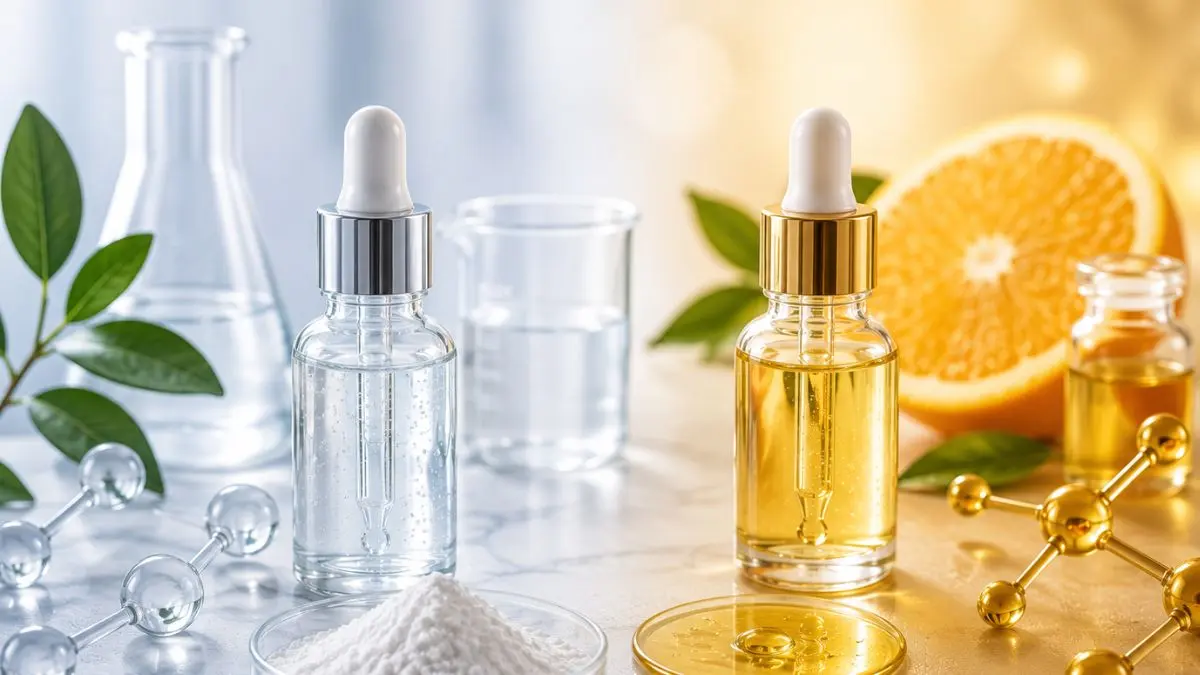
SAP goes in the water phase and THD in the oil phase, which lets you incorporate vitamin C derivatives into different phases of the same emulsion. This does not mean the combination has been clinically proven to deliver vitamin C to two specific skin depths.
Which one should you actually buy?
If your main concern is breakouts and the dark marks they leave, buy SAP. It is the only one of the two with a controlled trial behind it for exactly that problem, and it is more affordable. If your main concern is fine lines, dullness and firmness on dry or mature skin, buy tetrahexyldecyl ascorbate. The deeper penetration is worth the higher price for that job.
If you have tried a vitamin C serum before and it stung, went brown, or broke you out — the derivative was probably wrong for your skin, not vitamin C itself.
Frequently asked questions
Is sodium ascorbyl phosphate real vitamin C?
Yes. It is L-ascorbic acid with a phosphate group attached for stability, which your skin’s enzymes remove to release active vitamin C. It is a delivery strategy, not a substitute.
Which is better, SAP or tetrahexyldecyl ascorbate?
Neither is better overall — they do different jobs. SAP is water-soluble and has controlled trial evidence in acne, making it the stronger pick for oily, breakout-prone skin. THD is oil-soluble and penetrates deeper, making it the stronger pick for dry or ageing skin.
What percentage of sodium ascorbyl phosphate should I use?
The published acne trial used a 5% lotion, but that does not by itself define the correct percentage or processing method for every DIY formula. Follow the specifications for your exact raw material and design the concentration, pH and preservative system as part of the complete formulation.
Does vitamin C fade dark spots?
Vitamin C inhibits tyrosinase, the enzyme that starts melanin production, so it helps fade excess pigment gradually over months. It works best paired with daily sunscreen, since UV exposure drives the pigment production you are trying to reduce.
Can I use vitamin C with niacinamide?
Yes — the idea that they cancel each other out is a persistent myth built on decades-old laboratory conditions that do not reflect modern formulations. We covered this properly in Can You Mix Vitamin C and Niacinamide?
Does SAP need a low pH like L-ascorbic acid?
No. That is the main advantage of the derivative — it stays stable and effective without the low pH that makes pure L-ascorbic acid serums sting and oxidise.
Main concern dark spots or uneven pigmentation? See our Pigmentation, Melasma & Chubaba solutions →
Want to compare Vitamin C derivatives with Tranexamic Acid, Alpha Arbutin, 4-Butylresorcinol, Kojic Acid Dipalmitate and other pigment actives? Read Best Skin Brightening Ingredients: 10 Potent Actives Compared →
The bottom line
“Vitamin C” tells you almost nothing. The derivative tells you everything — which phase it dissolves in, how deep it goes, whether it will sting, and whether it will still be active in six weeks.
Match the derivative to your skin type rather than to the marketing, and vitamin C stops being the ingredient that disappointed you and starts being the one that works.
Explore the pigmentation & melasma guide
Melasma vs HyperpigmentationEpidermal vs Dermal — how deep?Why it's getting darkerHow long does it take to fade?
How to remove ChubabaWhat to Use for HyperpigmentationTreatment for dark skinTreat melasma without hydroquinoneDoes microneedling help?
Pigmentation, Melasma & Chubaba SolutionsFind your routine by concernChubaba Dark Patch CorrectorMelanin BreakerGuide: Why is it getting darker?
Best Skin Brightening Ingredients10 actives compared · the hubAlpha Arbutin4-ButylresorcinolKojic Acid DipalmitateMulberry Root Extract
NiacinamideVitamin C: SAP vs THDYou are hereMix Vitamin C & Niacinamide?L-GlutathioneTremella (hydration)