

How to Get Rid of Hyperpigmentation from Acne
How to Get Rid of Hyperpigmentation from Acne
You finally got the breakout under control. The pimple is gone. But the mark it left behind isn’t. Weeks later, sometimes months, that dark patch is still sitting there, and a lot of people call it a “scar”. It isn’t. An acne scar is structural damage to the skin from inflammation that went deep enough to disrupt collagen, either destroying it (leaving a dent) or overproducing it (leaving a raised mark). It’s permanent tissue change, not just pigment sitting on top.
Our pick for stubborn pigmentation: the Melanin Breaker — a high-potency formula with 4-Butylresorcinol, Tranexamic Acid and SymWhite® 377 to help fade melasma and dark marks.
What you’re looking at, those dark marks, has a name, a mechanism, and a treatment pathway that’s very different from how you’d approach a true acne scar. While some treatments, such as retinoids, chemical peels, and certain in-clinic procedures, can benefit both conditions, the underlying problem is different. Acne scars result from structural damage to collagen, whereas post-inflammatory hyperpigmentation is a pigment disorder. Understanding that difference is what determines whether you’re targeting texture or excess melanin.

It’s Not a Scar. It’s Your Skin’s Overreaction.
The clinical term is post-inflammatory hyperpigmentation, or PIH. It follows damage to the epidermis and/or dermis, with melanin depositing in the skin cells and sometimes in the deeper dermis too. Inflammation in the epidermis stimulates our melanocytes to produce more melanin and push that pigment into surrounding cells. In plain terms: when a pimple inflames your skin, your melanocytes, the cells that make pigment, get triggered into overdrive. They don’t just heal the area, they flood it with extra colour.
Inflammation from things like acne releases cytokines, prostaglandins, and reactive oxygen species. Those signals tell melanocytes to ramp up melanin production, which then gets passed along to surrounding skin cells. That’s the mechanism. It’s not damage in the structural sense – there’s no tissue loss or collagen disruption the way you’d see with true acne scarring (the pitted, textured kind). It’s a pigment response, which is good news, because pigment disorders can gradually fade over time and often respond well to appropriate treatment, although deeper dermal pigment may persist for years and can be much more difficult to clear than epidermal pigment.
Why This Hits Melanin-Rich Skin So Much Harder
Here’s where the science gets specific, and where most generic skincare advice falls apart, because most of it isn’t written with melanin-rich skin in mind. Postinflammatory hyperpigmentation is more prevalent among people with darker skin tones, particularly Fitzpatrick skin types IV to VI – these individuals have higher baseline melanin production and more reactive melanocytes. That’s not a minor footnote. A 2002 study on acne in skin of color found that 65.3% of African-American patients, 52.7% of Hispanic patients, and 47.4% of Asian patients developed acne-induced PIH – compared to a much smaller fraction in lighter skin types, where the same inflammation tends to show up as lingering redness instead.
And this is the part that genuinely frustrates me as someone who reports on this industry: PIH can last anywhere from a year to five years depending on how severe the original acne lesion was, which is why for a lot of acne sufferers, the dark mark becomes more distressing than the acne ever was. You clear your skin. The marks outlast the breakout by years. That mismatch is exactly why so many people end up reaching for harsh actives out of frustration, and that’s where things can go wrong.
Why Depth Matters More Than You Think
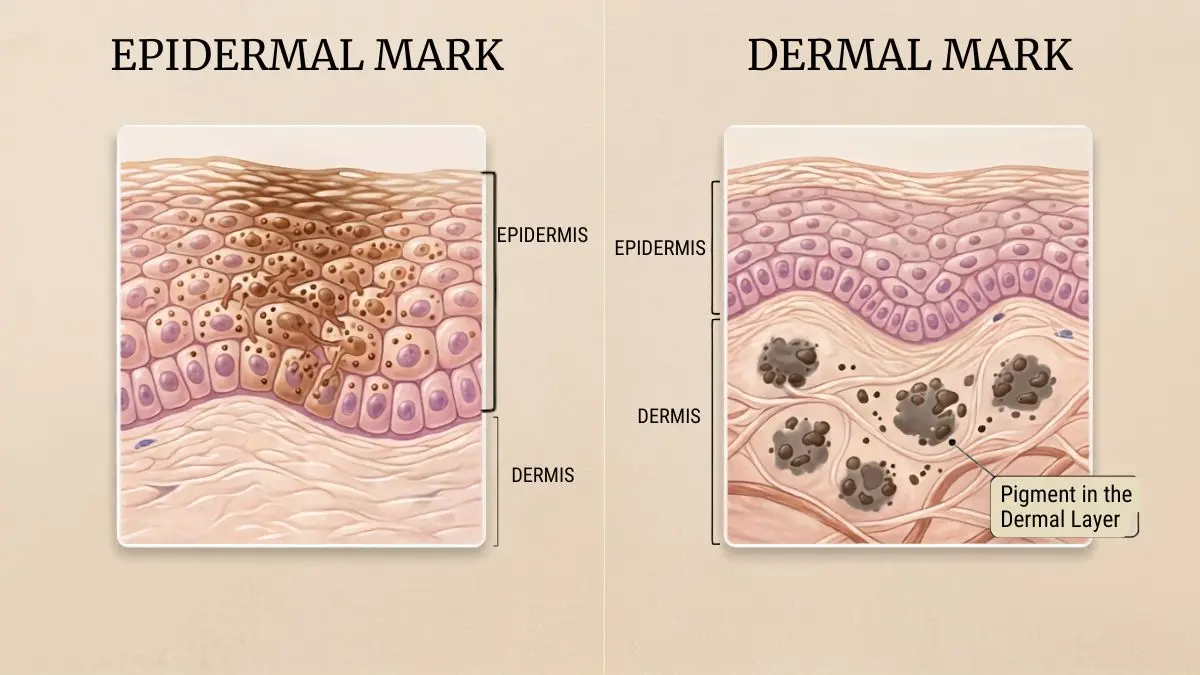
Not all PIH sits in the same place, and where it sits determines how stubborn it is. When PIH stays in the epidermis, there’s increased melanin production and transfer between skin cells, and it typically presents as tan, brown, or dark brown marks that can take months to years to clear without treatment. When the dark pigment sinks deeper into the skin (the dermis), special cleanup cells called macrophages “eat it up”, which is why that kind of mark sits longer and fades much more slowly than pigment sitting near the surface.
This is the single biggest reason people give up on products too early. If your mark has a blue-grey undertone rather than brown, you are likely dealing with dermal pigment, and topical tyrosinase inhibitors, the ingredient family I’ll get to next – physically cannot reach it the way they reach epidermal pigment. Tyrosinase inhibitors only work on epidermal hyperpigmentation, because that’s where melanin synthesis by tyrosinase actually happens. Dermal PIH needs patience, sun protection, and in resistant cases, professional intervention – not a stronger serum.
So What Actually Works? Here’s the Evidence, Ranked Honestly
I’m not going to tell you hydroquinone doesn’t work – it does for some, and it’s still considered a benchmark. But it comes with real costs, and I think you deserve the full picture before you put something on your skin for six months. The risk with hydroquinone is that irritation from 4% hydroquinone can actually worsen PIH, particularly in darker skin types, and prolonged use carries a risk of ochronosis, a stubborn, darkening condition that’s especially prevalent in melanin-rich skin. That’s the agent doing the opposite of what you bought it for.
Here are ingredients that lighten dark marks, but by no means do they work on everyone. I’ve personally found 4-n-Butylresorcinol to be one of the most effective. It’s a potent tyrosinase inhibitor that has demonstrated efficacy comparable to, and in some studies exceeding, hydroquinone, while generally producing less irritation. The reason you don’t find it in many formulas is because it is an expensive ingredient. For a deeper understanding of this ingredient, read 4-Butylresorcinol: Why This Potent Pigmentation Active Shines.
Here’s also other less known ingredients that work very well such as Symwhite 377. You can find out more about this ingredient and other skin brighteners by visiting Ingredients. And, if you want something effective that combines 4-Butylresorcinol, Symwhite 377 and Tranexamic acid in one formula, get our Melanin Breaker.
Tranexamic acid is another fantastic ingredient. It works by calming the inflammatory signal that triggers melanocytes in the first place – rather than just blocking the pigment after it’s made. That’s why it’s increasingly used alongside other actives instead of on its own.
Common skin brighteners
Alpha arbutin works by competitively inhibiting tyrosinase – binding to the enzyme’s active site because of its structural similarity to tyrosine – which reduces melanin synthesis without destroying melanocytes. That’s the real safety advantage over hydroquinone: it’s generally better tolerated, has a lower risk of irritation, and is less likely to trigger the rebound hyperpigmentation that can occur when more aggressive depigmenting agents are misused or overused.
Niacinamide earns its place by working through a completely different mechanism. Rather than blocking the tyrosinase enzyme directly, it reduces the transfer of melanin granules from melanocytes into surrounding skin cells. It’s well tolerated even on sensitive skin, available without a prescription, and its anti-inflammatory action makes it specifically useful for PIH caused by acne – since you’re treating the inflammation pathway, not just the pigment.
Licorice root extract is another gentle option worth knowing about. Its active compound, glabridin, inhibits tyrosinase while also calming inflammation – which makes it a smart pick specifically for acne-related PIH, since you’re treating the trigger and the pigment at the same time. It’s milder than 4-Butylresorcinol, so don’t expect dramatic results, but it layers well with stronger actives and is generally well tolerated even on reactive skin.
If you want Licorice Root Extract, Alpha Arbutin, and Niacinamide (Vitamin B3) working together in one formula, get our Pigmentation Night Serum.
To read more about other types of skin brightening ingredients, read Best Skin Brightening Ingredients.
Sun protection isn’t optional — it’s the foundation.
Daily broad-spectrum SPF 30+ is essential, because UV exposure actively darkens existing PIH and prolongs how long it takes to resolve. I’d go further: every active listed above will underperform without consistent SPF, full stop.
How to Get Rid of Hyperpigmentation from Acne- The Bottom Line
PIH is not a scar, it’s not permanent damage, and it’s not a sign your skin failed to heal properly – it’s melanocytes doing exactly what melanin-rich skin’s biology tells them to do under inflammation. The marks are real, the timeline is genuinely long, and the marketing claiming overnight fades is, frankly, lying to you. What the research actually supports is patience, consistent tyrosinase-pathway ingredients matched to where your pigment actually sits, and sun protection applied like it’s non-negotiable – because it is.
That’s the truth of it. No miracles. Just the science.


