What Microneedling Needles to Use on Face
What Microneedling Needles to Use on Face and Why It Matters
Understanding what microneedling needles to use on face is the foundation of safe and effective microneedling. While devices may look similar, the outcome depends entirely on needle depth, skin response, and how controlled the treatment is.
Table of Contents
- 0.25 mm- Is the Microneedling Needles Size for Surface Glow
- 0.5 mm- Is the Microneedling Needles Size for Refining Texture and Pores
- 1.0 mm- Is the Size to Hit The Threshold of Collagen Activation
- 1.5 mm- Is for Targeted Structural Repair
- 2.0 mm- If for Corrective Remodeling for Deep Scars
- Hyperpigmentation and Glow
- 12 vs. 36 Needles Cartridge
- Recommended Microneedling Needle Sizes for Each Area of the Face
- Conclusion: What Microneedling Needles to Use on Face
Choosing what microneedling needles to use on face determines whether the skin is simply refreshed on the surface or stimulated deeply enough to trigger collagen remodeling.
This is not just a technical setting on a device, it is the difference between surface glow and structural skin change.
Understanding What Microneedling Needles to Use on Face Based on Skin Layers
Deciding which needle size to use on your face depends entirely on what you want to achieve, as every depth triggers a different biological response. These are the needle sizes and what they do:
- 0.25 mm — surface renewal and absorption improvement
- 0.5 mm — texture refinement and mild collagen activity
- 1.0 mm — collagen stimulation and structural improvement
- 1.5 mm — deeper repair and scar response
- 2.0 mm — intensive corrective remodeling
In choosing your needle size, remember that while deeper settings increase the skin’s healing activity, they also bring more inflammation and longer downtime. Success is about balancing the depth with what your skin can comfortably handle.
Looking for the right microneedling cartridges? Click Here to take a look at these Professional Microneedling Replacement Cartridges
0.25 mm — Is the Microneedling Needles Size for Surface Glow
When your goal is a radiant, “glass skin” finish, choosing a 0.25 mm needle depth is the most effective approach. At this level, the treatment focuses entirely on surface renewal rather than deep structural changes. By creating controlled micro-channels in the very top layer of the skin, you make the surface much more receptive to skincare products and achieve an immediate brightening effect.
This superficial depth is ideal for:
-
Enhancing Skin Glow: Improving the skin’s light-reflecting quality.
-
Hydration Support: Allowing hyaluronic acid and other serums to bypass the surface barrier.
-
Maintenance: Keeping the skin texture smooth between more intensive treatments.
Because this is the most shallow application, it offers the fastest recovery time while providing a visible “refresh” to the complexion.
0.5 mm- Is the Microneedling Needles Size for Refining Texture and Pores
At the 0.5 mm range, the treatment moves beyond simple product absorption and begins to improve visible texture irregularities. This is the level where the skin starts to show an early collagen response without requiring significant downtime. It is a balanced starting point often used to treat enlarged pores, uneven skin feel, and the very first signs of aging.
1.0 mm- Is the Size to Hit The Threshold of Collagen Activation
A depth of 1.0 mm is one of the most important thresholds in microneedling, as this is where the treatment transitions into true collagen induction. By reaching this layer, you trigger structural rebuilding that improves skin firmness and smooths out fine lines over time. This setting is primarily used for general rejuvenation and mild acne scarring.
1.5 mm- Is for Targeted Structural Repair
At 1.5 mm, the device creates a much stronger regenerative response. While collagen production increases significantly at this level, inflammation also rises, which means sessions must be carefully controlled and spaced further apart. This depth is most effective for treating deeper wrinkles, established acne scars, and thicker or more resilient skin types.
2.0 mm- If for Corrective Remodeling for Deep Scars
This is the deepest setting commonly used on the face and is reserved for advanced remodeling. While it delivers a powerful healing response for deep acne scars or long-standing surgical marks, it requires a much longer recovery period and very careful application to avoid over-treating the tissue. Microneedling has been shown to help improve the appearance of acne scars in clinical studies.
Hyperpigmentation and Glow
When treating pigmentation, the goal is controlled delivery rather than deep injury. A range of 0.5 mm to 1.0 mm is typically used because it allows brightening ingredients—like tranexamic acid—to reach the melanocytes without causing the excessive inflammation that can sometimes make pigmentation worse.
Needle Thickness and Material
The success of the treatment isn’t just about depth; it’s also about the needle itself. Thin needles (high gauge) are designed to enter the skin easily and create cleaner channels with less trauma. Conversely, thicker needles provide the stability needed to maintain their structure at deeper settings, though they can increase resistance if the device isn’t well-engineered.
The material also matters. Titanium needles offer a bit of flexibility and are highly resistant to corrosion, providing a “softer” feel during the treatment. Surgical steel, however, is prized for its rigidity and precision, allowing for a more accurate entry and maintaining a sharp edge for the duration of the session.
From surface glow at 0.25 mm to deep structural repair at 1.5 mm, the Dr. Pen Microneedling Device offers the versatility required for professional-level facial mapping. It allows you to transition seamlessly between treating delicate areas like the forehead and targeting established scarring on the cheeks, all with one stable, ergonomic tool.
12 vs. 36 Needles Cartridge
The needle count changes how the device performs. A 12-needle cartridge offers more precision and is more efficient at reaching deeper layers, making it the better choice for scars and structural work. A 36-needle cartridge provides faster coverage and more surface diffusion, which is ideal for “glow” treatments and skin polishing.
Recommended Microneedling Needle Sizes for Each Area of the Face
The effectiveness of microneedling isn’t just about the needle; it’s about the consistency of delivery. In lower-quality devices, the motor speed (RPM) fluctuates, which can cause the needles to “drag” or “hook” the skin rather than creating a clean vertical channel. A high-torque, stable motor ensures that every micro-channel is uniform, which is the baseline for predictable healing.
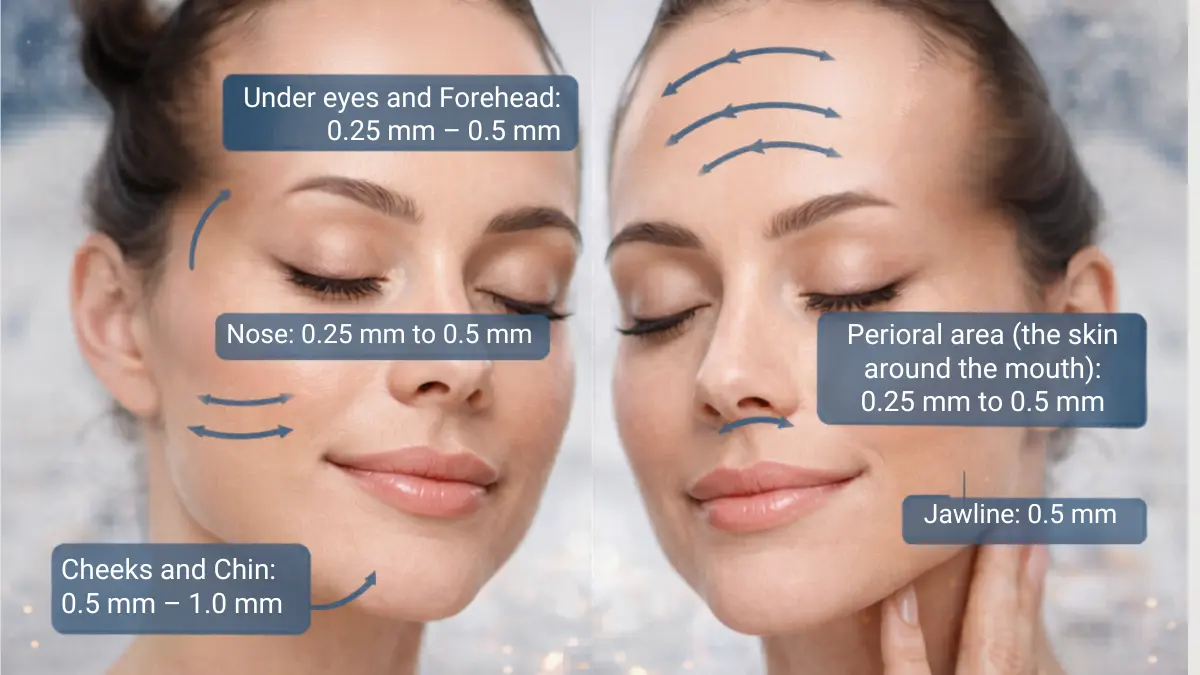
However, a high-performing device is only as good as the operator’s Facial Mapping. Because skin thickness varies drastically across different zones, a “one depth fits all” approach is ineffective and potentially damaging. You need to change the depth according to the facial area you are treating.
- Under eyes and Forehead: 0.25 mm – 0.5 mm
- Cheeks and Chin: 0.5 mm – 1.0 mm
- Targeted Scars: 1.0 mm – 1.5 mm
- Nose:0.25 mm to 0.5 mm
- Perioral area (the skin around the mouth): 0.25 mm to 0.5 mm
- Jawline: 0.5 mm
- Neck: 0.25 mm to 0.5 mm
Conclusion: What Microneedling Needles to Use on Face
Ultimately, professional microneedling is not about using the deepest setting possible, but about selecting the precise depth for the skin’s specific condition. When chosen correctly, the process improves texture and supports collagen in a predictable, controlled way. Real results come from precision-not intensity.
For more on Microneedling Read: The Ultimate Microneedling Guide 2026: Benefits, Needle Sizes & Safety