Skincare, The Truth, The Truth Blog

Microneedling Healing Stages

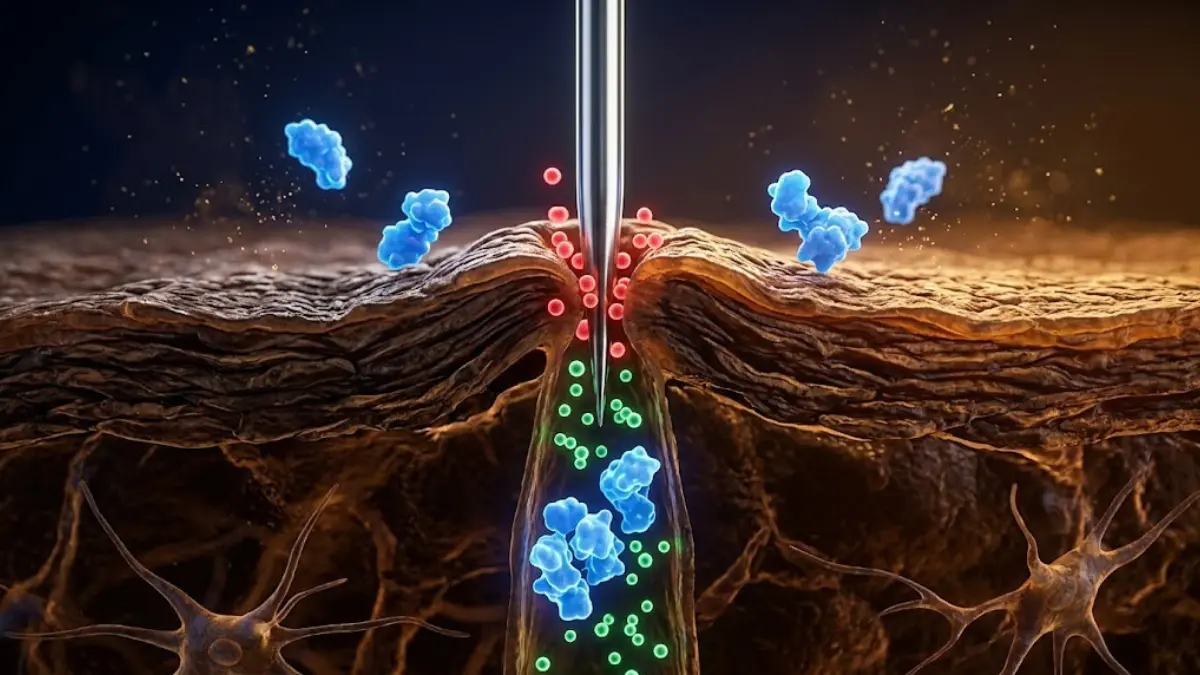
Microneedling Healing Stages. Cross-section of a microneedle bypassing the skin barrier and 500-Dalton Rule.

Microneedling Healing Stages: A Detailed Day-by-Day Timeline

Microneedling is an effective clinical treatment for improving skin texture, reducing scars, and softening wrinkles. However, as an investigative journalist and formulator, I always emphasize a critical truth: the real results don’t happen while the needles are in your skin. They happen during the complex biological communication of repair that follows.

Understanding the microneedling healing stages allows you to manage expectations and support your skin’s natural repair mechanisms rather than working against them.

The Road to Regeneration: Your 7-Day Recovery Summary for the Microneedling Healing Stages

Day 1: The Inflammatory Surge and Platelet Activation (Microneedling Healing Stages Begin)

Microneedling Healing Stages 2 Day 1 inflammatory signaling in the dermis following microneedling, with macrophages releasing cytokines (Interleukin-1, TNF-α).

Caption: At the exact point of entry, the skin’s natural filtration system is temporarily suspended. This visualization captures the Immediate Breach, where the 500-Dalton Rule no longer applies; all molecular weights, from the large, bulky blue clusters to the small green spheres, flood the dermis through the open microneedle channel simultaneously. This indiscriminate delivery is the “trigger” event,  followed by a rapid SOS signaling cascade. This biological response is illustrated by teal tracer sparks (the release of Interleukin-1) and an amber glow (the recruitment of Growth Factors), as the skin prepares to close the bypass and begin the work of remodeling.

The story of your skin’s transformation begins the very second the treatment ends. While the needles are active, they create a physical bypass—essentially holding the “doors” of your skin open so that large-molecule ingredients can drop directly into the dermis. However, the moment the needles are withdrawn, the skin’s elastic recoil snaps those entry points shut.

This is a critical turning point I call the Gatekeeper Shift. Once those physical channels close, the 500-Dalton Rule returns as the law of the land. In formulation science, a Dalton is a unit of molecular weight. This rule dictates that without a physical “hole” in the skin, only the smallest, most agile molecules (under 500 Daltons) can pass through the barrier. Anything “bulky” applied after this window will simply sit on the surface.

As this gate slams shut, your skin enters the Inflammatory Phase. You will notice redness, warmth, and a sensation similar to a mild sunburn. Beneath the surface, your platelets clump together to form a temporary plug, but their true mission is chemical: they release a surge of signaling molecules like Interleukin-1 and TNF-α. These molecules act as a “biological SOS,” summoning the repair cells that will orchestrate the entire reconstruction process. During these first 24 hours, the goal is to support this signaling without disruption, allowing the biological engine to rev up undisturbed.

Day 2–3: The Construction Window and Fibroblast Recruitment (Microneedling Healing Stages in Progress)

As the initial redness fades, sometimes in less than two days, your skin shifts from “signaling” into active construction, known as the Proliferative Phase. This is the stage where the skin’s architects, the fibroblasts, migrate into the treatment zone to begin the heavy lifting. They start synthesizing the Extracellular Matrix (ECM), a hydrated scaffold of hyaluronic acid and fibronectin that serves as the foundation for all future tissue rebuilding.

During this window, you may notice your skin feels tight, dry, or slightly rough. While it is tempting to reach for a scrub to “smooth” this texture, it is vital to resist. Your surface skin is currently acting as the protective roof of a busy construction site. Stripping that roof away through early exfoliation forces the skin to divert its metabolic energy away from deep collagen building and toward emergency “surface repair”. For melanin-rich skin (skin of color), this unnecessary stress is a primary trigger for unwanted hyperpigmentation (PIH).

Day 3–5: Re-epithelialization and The Flaking Stage (Microneedling Healing Stages Surface Repair)

By the third or fourth day, some individuals experience mild flaking as old epidermal cells shed to make room for the new. This is the process of re-epithelialization, where keratinocytes migrate laterally to close the micro-channels completely, restoring the skin’s protective barrier and normalizing Transepidermal Water Loss (TEWL).

Even if the surface looks healed, the dermal architecture is still very much under construction. You must resist the urge to pick or scrub at the skin. Beneath the surface, your body is still orchestrating the organization of collagen and the Extracellular Matrix (ECM).

Day 7: Surface Normalization and Early Healing Insights (7 Days After Microneedling)

By the end of the first week, your skin may look normal to the naked eye. You might notice a gentle “pink glow,” which is actually a sign of angiogenesis, the formation of new capillaries that enhance oxygen and nutrient delivery to your regenerating tissue.

At this seven-day mark, Type III collagen is still being synthesized. This early-stage collagen is thinner and more flexible than the mature Type I collagen we are ultimately aiming for. It is a common mistake to assume that surface healing indicates the end of the microneedling healing stages; in reality, the deepest dermal processes will continue for several weeks.

Weeks 2–4: The Conversion Stage (The Hidden Phase of Microneedling Healing Stages)

During the second and fourth weeks, your skin appears entirely normal, yet the most significant remodeling is happening out of sight. This is the stage where Matrix Metalloproteinases (MMPs) break down the temporary Type III collagen scaffold so that fibroblasts can deposit Type I Collagen. These are the dense, resilient fibers that provide the long-term elasticity and strength we associate with youthful skin.

1–3 Months: Reaching the Biological Peak (What Happens After Microneedling)

Real, structural changes finally become visible in this window. This is when you will start to see the “Expert” results:

  • A noticeably smoother skin texture.

  • The visible reduction of fine lines and wrinkles.

  • Refined pores and firmer, more resilient skin.

The biological reality is that the conversion from Type III to Type I collagen is slow and ongoing, typically peaking between three to six months post-treatment. I recommend waiting at least 4–6 weeks between sessions to allow for total dermal stabilization throughout all microneedling healing stages.

Microneedling Healing Stages- day 14

Caption: The final stage. Mature Fibroblasts (now more radiant) begin contracting the tissue, while robust bundles of Mature Type I Collagen ( pearlescent copper) align in thick, parallel arrays. This structured network tightens and replaces the temporary scaffolding from Day 3 , completing the transformation from a protective filter into a strong, resilient foundation.

Why Understanding Microneedling Healing Stages Matters

Many people expect instant results, but microneedling is a marathon of biological signaling and tissue remodeling. Patience is an essential tool in clinical skincare. Every stage, from the initial inflammatory signal to the final collagen conversion, is a crucial link in the chain.

In the end, Healing = Results. Visible surface changes are only part of the story. Underneath, your skin is rebuilding, strengthening, and realigning its fibers to achieve lasting improvements.

Beyond Microneedling Healing Stages

The healing process is only half the story; the tools and protocols you choose are what define your final results.

author-avatar

About Sharika Regchand

Sharika Regchand is a veteran investigative journalist and researcher with over two decades of experience in high-stakes legal and investigative reporting. Now a skincare author and formulator, she applies that same investigative rigor to the science of cosmetic chemistry, conducting in-depth interviews with skincare users for research purposes, analyzing real-world outcomes, and deconstructing complex studies to uncover the definitive truth behind ingredient efficacy, formulation stability, and skin safety.

Leave a Reply