
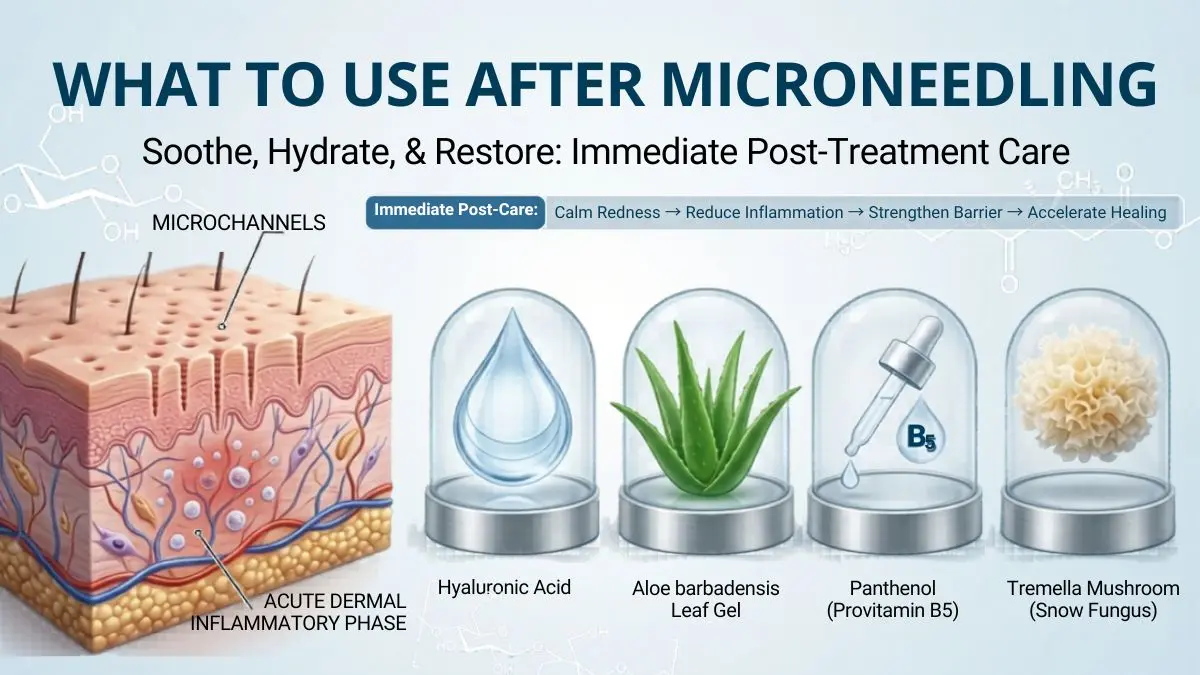
What to Apply After Microneedling (And What to Avoid)

What to apply after microneedling matters more than what you apply at any other moment in your skincare life — because for a few hours, your skin has no gatekeeper. The safest answer is boring on purpose: sterile hyaluronic acid, a bland barrier moisturiser, and nothing else for 24 hours. The active serums you love are the ones most likely to hurt you here.
That sounds overcautious until you read the case reports. So let’s read them — and then walk through the full recovery plan, phase by phase.
Protect your clinic before you treat another client. Download the Microneedling Intake, Consent & Disclaimer Forms (Editable Clinic Compliance System)
Table of Contents
- What the Case Reports Actually Show
- The Sterility Rule (What to Use During and Immediately After)
- The Cooling Phase (Immediate – Heat Dissipation)
- The Sealing Phase (Usually 12–24 Hours)
- The Corrective Actives Stage (48 Hours – 7 Days)
- When to Wash Your Face
- What NOT to Apply
- The Professional Recovery Schedule
- Frequently Asked Questions
Microneedling, or collagen induction therapy, is a powerhouse for skin remodeling, but the treatment doesn’t end when the needles stop. Microneedling creates controlled micro-channels in the skin that temporarily and substantially increase how much of a topical product gets in. You will see specific multipliers quoted for this — they come from laboratory and animal permeation models rather than from clinical skin, so treat them as a demonstration of the principle, not a number to rely on. While this makes the skin highly responsive to skincare, it also leaves the barrier compromised and physically “open”. Reviews of the technique, such as Microneedling: Advances and Widening Horizons, describe this enhanced delivery and the wound-healing response it sets off. That is where post-treatment care matters: because the barrier is temporarily disrupted, clinicians generally recommend gentle, non-irritating care in the first 24 to 48 hours — particularly for anyone prone to post-inflammatory hyperpigmentation (PIH). What you apply may influence the skin’s healing environment and the risk of unnecessary inflammation; it is not what decides your final result, but it is the part most easily got wrong.
The uncomfortable truth is that enhanced delivery is not selective. It does not distinguish between an ingredient your skin welcomes and one your immune system considers an intruder. Whatever is sitting on the surface goes in — not “absorbs better”, goes in, into the dermis, past the checkpoint.
What the Case Reports Actually Show
In a report published in JAMA Dermatology, dermatologists described three women in their 40s to 60s who developed facial granulomas — persistent inflammatory lumps — after microneedle therapy for skin rejuvenation. Biopsies confirmed foreign body–type granulomas. In two of the three cases, patch testing came back positive for the vitamin C serum that had been applied with the treatment. One patient also developed a systemic hypersensitivity reaction.
The authors made a point worth remembering every time you needle: applying a cosmeceutical before microneedling effectively results in intradermal tattooing of the product. You are not treating your skin with it. You are implanting it.
This is not a one-off. A 2023 case in JAAD Case Reports documented a sarcoidal granulomatous reaction to microneedling with vitamin C serum. And a 2024 report described a treatment-refractory granulomatous reaction — meaning it resisted treatment — following microneedling with transepidermal delivery of vitamin C, niacinamide and botanical extracts.
Read that ingredient list again. Vitamin C. Niacinamide. Botanical extracts. There is nothing exotic there. Those are the contents of half the bathroom cabinets in the world, and they are perfectly safe applied to intact skin. The problem was never the ingredients. The problem was the route. An ingredient’s safety record on intact skin tells you nothing about its safety when it is delivered into the dermis. Cosmetic products are tested, formulated and preserved for topical use — sitting on the surface of unbroken skin. None of that testing anticipates the product being injected into living tissue, which is functionally what microneedling does.
A Note on Professional Protocols
If you have had microneedling performed in a clinic, don’t be surprised if your practitioner applies a recovery cream or sunscreen before you leave. Post-procedure protocols vary between dermatologists, aesthetic doctors and skin therapists. Many professionals use barrier-support products and, in some cases, mineral sunscreens immediately after treatment based on the treatment depth, the products available in their practice, and whether the patient will be exposed to sunlight on the journey home.
This article takes a deliberately conservative approach to at-home care. The goal is not to replace your practitioner’s instructions, but to explain the reasoning behind post-treatment recommendations and help you avoid the products most commonly associated with irritation and published adverse reactions. Ultimately, if your treating practitioner has provided you with a written aftercare protocol, that should take precedence.
The Sterility Rule: What to Use During and Immediately After
Sterile hyaluronic acid, and very little else.
Hyaluronic acid is the standard glide medium for good reasons: it is a molecule your skin already contains, it is not biologically active in the way an acid or retinoid is, it holds water, and it has the lowest sensitisation risk of any option available to you.
Get our Microneedling Hydrating Glide Serum .
What to Apply After Microneedling at Home (Step-by-Step Guide)
1. The Cooling Phase (Immediate – Heat Dissipation)
This stage is about managing “clinical heat”. For most, this lasts between 2 to 12 hours. If your skin still feels “on fire” or is radiating heat, stay in this phase and use only water-soluble, cooling ingredients such as the following:
- Humectants & Soothing Actives
Hyaluronic Acid (HA), Tremella Mushroom, Aloe Vera, Panthenol (Vitamin B5), Beta-Glucan, Centella Asiatica (Cica), Madecassoside, Allantoin, and Snail Mucin.
Visit Ingredients to take a look at our humectants, soothing agents, and regenerative actives.
- Regenerative Bio-stimulants
Exosomes, PDRN (salmon DNA), polynucleotides, growth factors and copper peptides have become some of the most talked-about ingredients in the microneedling space because they are marketed to support skin recovery and improve the appearance of aging skin. However, these ingredients are not all treated equally by regulators. Exosome products remain the most controversial and, as of 2026, no exosome product has received FDA approval for therapeutic or aesthetic use in humans. By comparison, PDRN and polynucleotides are widely used in aesthetic clinics in countries such as South Korea, while copper peptides have long been used in cosmetic skincare formulations. The takeaway is simple: an ingredient’s popularity does not necessarily mean it has the same regulatory status everywhere. You should understand what is being used, where it comes from, and whether it is appropriate for professional or at-home use.
- The Aqueous Rule
For at-home care, many practitioners recommend sticking to simple, water-based serums during the initial cooling phase. Applying heavy oils or creams while the skin is hot traps that heat, which can lead to increased swelling or prolonged redness.
- The “Moisture Magnet” Logic
Hyaluronic Acid pulls moisture into the tissue to keep it supple while allowing clinical heat to escape. However, because HA does not “seal” the skin, you must transition to Stage 2 as soon as the heat subsides to prevent the serum from evaporating and causing dryness.
- Melanocyte Stabilization
If you suffer from melasma, hyperpigmentation, or Chubaba, your instinct is to apply brighteners now. Don’t. Applying the wrong actives too early can trigger “rebound pigmentation”. If a product stings on Day 1, wash it off immediately, that sting is a signal of potential post-inflammatory darkness.
The goal in the first 24 hours is Melanocyte Stabilization. If you irritate the pigment-producing cells (melanocytes) while they are already “on high alert” from the needles, they can overproduce melanin as a defense mechanism.
2. The Sealing Phase (Usually 12–24 Hours)
Once the “clinical heat” has subsided and the skin no longer feels hot to the touch, you can move to protecting the barrier. This usually happens after the first 12 hours.
- Seal the Barrier: Introduce a fragrance-free, professional-grade moisturizer. Look for skin-identical lipids such as Ceramides and Squalane to “seal” the barrier. This prevents Transepidermal Water Loss (TEWL) and locks in the hydration from Stage 1.
PRODUCT RECOMMENDATION: Barrier Repair Cream.
- Occlusives (Facial Oils & Vaseline): Wait until at least 12–24 hours post-treatment. Using them too early can trap residual heat and interfere with the natural inflammatory drainage.
- Sunscreen: Not in the first 24 hours, while the channels are still open. From day 2, sunscreen is non-negotiable — your UV defences are compromised, and this is precisely the window where post-inflammatory hyperpigmentation gets started: the outcome you were probably trying to treat in the first place.
3. The Corrective Actives Stage (48 Hours – 7 Days)
As the skin enters the proliferative phase (which is when the skin starts rebuilding itself by producing new collagen, forming new blood vessels, and closing the micro-injuries created during microneedling), you can begin reintroducing performance ingredients. However, rushing this step can trigger post-inflammatory hyperpigmentation (PIH). Reintroduce actives one at a time, not all at once — so that if something does react, you know what caused it.
- Niacinamide is best held back until at least 48 hours, and realistically day 3, applied to skin that has closed rather than needled into open channels — niacinamide appears in at least one published granulomatous reaction following transepidermal delivery. From day 3 onward it is a sensible choice for managing redness and regulating pigment. The timing is what matters here, not the ingredient. If using a high-strength formula (above 5%), wait until the skin is no longer reactive.
- Vitamin C is the most frequently implicated product in the published granuloma case reports. Standard L-ascorbic acid is also highly acidic — wait at least 72 hours for gentler derivatives, and hold strong L-ascorbic acid serums until day 5–7, once all redness has settled. Use vitamin C the week before and the week after — not on needled skin.
- Retinoids are highly stimulatory. Depending on treatment depth, reintroduction should only occur between Day 5 and Day 7, once the barrier function is fully restored.
When to Wash Your Face After Microneedling
One of the most frequent concerns is the first wash. As a general guideline, wait a minimum of 6 to 12 hours, though 24 hours is the ideal window for deeper clinical treatments to allow the micro-channels to close naturally.
When you perform the first wash:
- Use only lukewarm water and a gentle, non-active cleanser.
- Avoid all scrubs, cloths, or mechanical exfoliation.
- Pat dry gently with a clean, single-use paper towel or a fresh microfiber cloth.
What NOT to Apply is as Important as What to Apply After Microneedling
To protect your investment and ensure superior collagen quality, you must strictly avoid anything that increases inflammation, introduces foreign material, or disrupts the pH during the acute phase:
- Vitamin C serums during treatment. The single most common thread in the published granuloma reports. Not on needled skin.
- Retinoids. Irritating on intact skin; on compromised skin, an invitation to prolonged inflammation.
- Exfoliating acids (AHAs and BHAs). You have just exfoliated far more aggressively than any acid could. Stacking them is not additive, it is destructive.
- Fragrance, essential oils and alcohol-based toners. Fragrance is the leading cause of cosmetic contact allergy, and you have removed the barrier standing between it and your immune system.
- Botanical and essential-oil-rich serums. “Natural” describes an origin, not a safety profile. Plant extracts feature in the case literature.
- Make-up for 24 hours. Pigments and silicones in open micro-channels are exactly the foreign material granulomas form around.
- Sun, sweat, gym and swimming pools for 48 hours. Chlorine and sweat in fresh channels; also, heat prolongs redness.
Don’t risk compliance gaps or missing consent documentation in your practice. Get the Microneedling Intake, Consent & Disclaimer Forms (Editable Clinic Compliance System) used for professional clinic standards.
The Professional Recovery Schedule
For at-home care, many practitioners prefer avoiding sunscreen for the first several hours after microneedling while the skin remains warm and reactive. Others routinely apply a mineral sunscreen immediately following professional treatments, particularly if patients will be exposed to sunlight on the journey home. If your practitioner has provided a written aftercare protocol, follow those instructions. From day 2 onward, sunscreen is non-negotiable — your UV defences are compromised, and this is precisely the window where post-inflammatory hyperpigmentation can begin.
- During and immediately after (0–1 hour): Hyaluronic acid only. Nothing else touches your face.
- Day 0–1: Focus on hydrating and calming “clinical heat”. Use only water-based humectants until the skin cools, then a plain barrier moisturiser. No actives. No make-up. Do not touch your face with unwashed hands. Expect it to look and feel sunburnt — that is a normal inflammatory response, not a complication.
- Day 2–3: Gentle cleanser, intensive barrier support (Ceramides), and sunscreen the moment you go outdoors. Niacinamide from day 3, applied to skin that has closed.
- Day 4–7: Continue with Ceramide-rich moisturizers and begin the gradual reintroduction of your standard corrective actives — retinoids and exfoliating acids last, and only once all redness and sensitivity have fully resolved.
Frequently Asked Questions
Can I use niacinamide after microneedling?
Not during treatment or in the first 48 hours. Niacinamide appears in at least one published granulomatous reaction case following transepidermal delivery. From around day 3, applied to healed skin, it is a sensible barrier-support choice — the timing is what matters, not the ingredient.
Can I use vitamin C after microneedling?
Not on the day. Vitamin C serum is the most frequently implicated product in the published granuloma case reports. Reintroduce it once your skin has fully settled, from about day 5 to 7.
Can I apply sunscreen after microneedling?
For at-home care, many practitioners prefer avoiding sunscreen for the first several hours after treatment. Others use mineral sunscreens immediately following professional procedures. If you have received written aftercare instructions from your practitioner, follow those recommendations.
When can I start using actives again after microneedling?
Around day 5 to 7 for most actives, once redness and sensitivity have completely resolved. Reintroduce them one at a time so that if something does react, you know what caused it.
What serum do you use with microneedling?
Sterile hyaluronic acid, used as a glide medium. It is inert, hydrating, low-risk, and the only category with a genuinely good safety case for being delivered into the dermis. See our guide to the best microneedling serum for the full comparison.
Can I use a sheet mask or collagen mask after microneedling?
Not in the first 24 hours. Sheet masks are not sterile and typically contain fragrance, preservatives and botanical extracts — the exact category implicated in reaction reports. Wait until the barrier has closed.
The Bottom Line
The most common mistake with what to apply after microneedling is treating the hour afterwards as an opportunity, when it is a vulnerability. The reasoning feels sound — my skin absorbs so much better now, let me use my best serum — and it is precisely how the people in those case reports ended up with granulomas that outlasted the treatment by years.
Be boring for 48 hours. Sterile hyaluronic acid, a bland moisturiser, sunscreen from day two, actives from day five. The results come from the needling, not from what you put on top of it.
If you are treating clients rather than yourself, the aftercare protocol is not optional — it is a documented part of your duty of care, and it belongs in writing. Our Professional Microneedling Training Manual covers protocol and aftercare properly.
READ: The Ultimate Microneedling Guide 2026: Benefits, Needle Sizes & Safety
This article is for educational purposes and may include general clinical guidance. Always follow your practitioner’s post-treatment protocol if provided.