
Mandelic Acid Powder: Why It’s the Gentlest AHA for Skin of Colour
Mandelic Acid Powder is a high-molecular-weight Alpha Hydroxy Acid (AHA) derived from bitter almonds, used in skincare formulation for controlled, slow-penetration exfoliation. Because its molecules are larger than those of Glycolic Acid, it works more gradually on the skin’s surface, making it the AHA formulators reach for most often when it comes to sensitive or melanin-rich skin.
I introduce Mandelic Acid to clients more often than any other acid, and it’s usually for the same reason: they’ve already been burned by something stronger.
Shop professinal grade Mandelic Acid Powder
What Is Mandelic Acid Powder, Exactly?
Mandelic Acid is extracted from bitter almonds and belongs to the AHA family, alongside more familiar names like Glycolic and Lactic Acid. What sets it apart is molecular size. A larger molecule means slower penetration into the skin, which translates to gentler, more controlled exfoliation rather than the fast, sometimes uneven action of smaller-molecule acids.
How It Actually Works on Skin
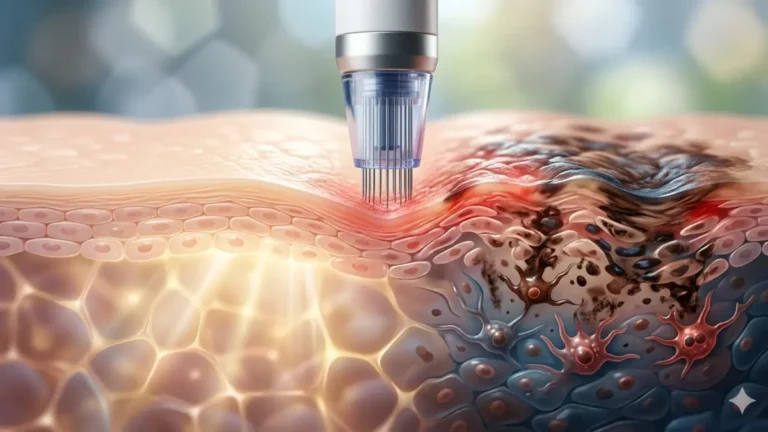
Exfoliation works by loosening the bonds holding dead surface cells together, allowing them to shed and reveal smoother, more evenly toned skin underneath. Because Mandelic Acid penetrates slowly, it does this without the sudden barrier disruption that triggers post-inflammatory hyperpigmentation, which is the single biggest risk factor I see in clients trying to self-treat pigmentation with the wrong acid.
That slow, steady action is exactly why it’s considered the AHA least likely to cause irritation or post-inflammatory hyperpigmentation, especially on deeper skin tones. While fast-penetrating acids can trigger inflammation, and inflammation can make existing pigmentation darker, Mandelic Acid works with the skin’s natural tolerance instead of pushing it beyond its limits.
Grab your 3 percent mandelic acid exfoliant- Pigmentation Exfoliator
Who Should Be Using It
Mandelic Acid Powder is suitable for all skin tones, including Black, Indian, Coloured, and White skin, and is particularly well suited to sensitive skin or skin prone to post-inflammatory hyperpigmentation. It is fully water-soluble, used at a 1 to 10 percent rate in finished cosmetic products.
It Works Better Paired, Not Alone
Like most exfoliating acids, Mandelic Acid performs best as part of a considered routine rather than carrying the whole job itself. We typically pair it with Allantoin and Aloe Vera to support skin soothing and comfort during exfoliation.
In a serious pigmentation protocol, Mandelic Acid also plays a specific role: it’s the “Gentle Exfoliant” stage that clears the buildup blocking brightening actives like Tranexamic Acid and Alpha Arbutin from penetrating properly. That’s exactly the role it plays in our own Pigmentation Exfoliator, where it’s used at 3%, and in Chubaba Remover Night Step 1, where it’s paired at 2% alongside PHAs, deliberately kept controlled to avoid triggering rebound darkening on darker skin tones.
Quick Answers
Is Mandelic Acid safe for sensitive or melanin-rich skin?
Yes, it is considered the AHA least likely to cause irritation or post-inflammatory hyperpigmentation, making it a common first choice for deeper skin tones.
What percentage of Mandelic Acid should be used in a formulation?
A usage rate of 2 to 10 percent is typical in finished cosmetic products.
How is Mandelic Acid different from Glycolic Acid?
Both are AHAs, but Mandelic Acid has a larger molecular structure, so it penetrates the skin more slowly and gently than Glycolic Acid.
Where to Go From Here
If you are formulating your own exfoliating routine, our Mandelic Acid Powder is available with full formulation guidelines and technical specs on the product page.
Read Chemical exfoliation-all you need to know to get a better understanding of the different types of exfoliants, so that you know what they all do.
This article is based on formulation experience and interpretation of published cosmetic ingredient data. Individual results will vary depending on skin type, environment, and consistency of use. Nothing in this article constitutes medical advice. Our raw ingredients are for cosmetic and personal care formulation only, external use only. We recommend working with a qualified chemist or formulator if you are not advanced in formulating.