
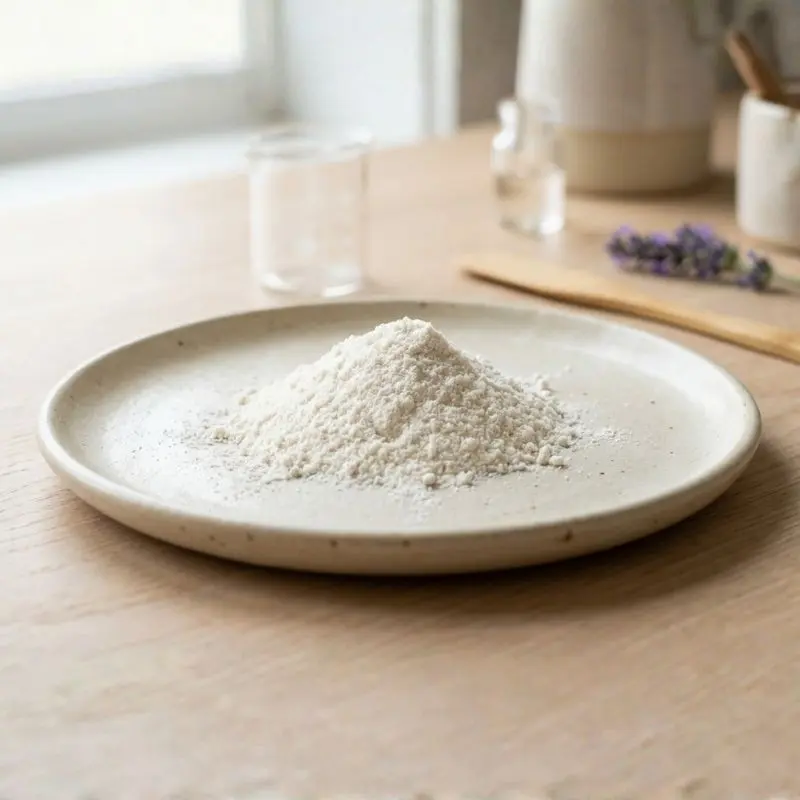
Mandelic Acid Powder
R70,00
A gentle exfoliating acid (AHA) made from almonds. Its larger molecule sinks in slowly, so it smooths and brightens without the irritation stronger acids cause — a safe choice for all skin tones, including darker skin.
INCI: Mandelic Acid
Benefits & How It Works
Mandelic acid is an alpha hydroxy acid (AHA) made from bitter almonds. Its molecule is bigger than glycolic acid’s, so it works into the skin more slowly and gently. That slow action is the point: it lifts away dead surface cells and smooths texture without the sudden sting and barrier damage that can leave darker skin with new dark marks. It is usually the first acid to reach for if stronger acids have irritated your skin before.
How to Use & Formulation Specs
- Usage rate: 2%–10% (start low and build up)
- Solubility: fully water-soluble
- pH: the usual AHA range, around 3.5–4
- Texture: lightweight and non-greasy in water-based serums and toners
- Pairs well with: Allantoin to keep the formula soothing
See It in a Formulation
- Pigmentation Exfoliator (contains 3% mandelic acid)
- Chubaba Remover Night Step 1 (contains 2% mandelic acid)
More Information
Mandelic Acid Powder, derived from bitter almonds, Mandelic Acid is a high-molecular-weight Alpha Hydroxy Acid (AHA). Because its molecules are larger than those of Glycolic Acid, it penetrates the skin more slowly, which makes it a preferred choice for formulations targeting sensitive skin or those prone to post-inflammatory hyperpigmentation. It is suitable for all skin tones, including Black, Indian, Coloured, and White skin, and is the AHA least likely to cause irritation or post-inflammatory hyperpigmentation on deeper skin tones.
Mandelic Acid Powder is usually the first acid I introduce to a client who has been burned by AHAs such as glycolic acid in the past. Because it penetrates the skin more slowly than smaller-molecule acids, it delivers meaningful exfoliation without the sudden barrier disruption that triggers post-inflammatory hyperpigmentation on melanin-rich skin, which is the single biggest risk factor I see in South African clients trying to self-treat pigmentation with the wrong acid. In my own formulation work, this larger molecular size is not a limitation, it is the entire point: slower penetration means a more even, controlled result instead of the patchy over-exfoliation that leaves reactive skin worse off than before.This is also why Mandelic Acid consistently comes recommended for South African skin specifically. Between hormonal melasma, sun-driven pigmentation, and the post-inflammatory darkening that follows acne or irritation, most of the pigmentation I see has an inflammatory part at its root, and an acid that exfoliates without provoking that inflammatory response is doing more than half the work before any brightening active even gets applied.Performance Profile
- Gentle Resurfacing: Supports natural turnover by loosening the bonds of dead surface cells.
- Refining: Helps improve the appearance of skin texture and visible pores.
- Clarity: Often used in formulations for acne-prone skin and uneven tone.
The ShaRique Synergy
Mandelic Acid rarely works alone in a serious pigmentation protocol. In my investigative guide on treating melasma without hydroquinone, I classify large-molecule acids like Mandelic Acid as the essential "Gentle Exfoliant" stage of a proper multi-pathway routine, clearing the buildup that blocks brightening actives like Tranexamic Acid and Alpha Arbutin from penetrating properly. You'll find it playing exactly this role in both our Pigmentation Exfoliator (at 3%) and Chubaba Remover Night Step 1 (at 2%, alongside PHAs), where the percentage is deliberately kept controlled to avoid triggering the rebound darkening that aggressive, poorly-dosed acids cause on darker skin tones. If you're formulating your own routine around it, start low and build up slowly; the goal is consistency, not intensity.Notice: For cosmetic and personal care formulations only.
External Use Only. We recommend working with a chemist or an experienced formulator if you are new to acid stabilization.
Frequently Asked Questions
Is mandelic acid safe for dark skin? Yes — it is the AHA least likely to cause irritation or new dark marks on melanin-rich skin.
How is it different from glycolic acid? Its bigger molecule sinks in more slowly, so it is gentler.
What strength should I use? Start around 3–5% and build up; 2–10% is the usual range.
You may also like…
Related products
-
L-Glutathione Powder (99% Pure Active)
R105,00Select options This product has multiple variants. The options may be chosen on the product page -

Tetrahexyldecyl Ascorbate
R249,00Select options This product has multiple variants. The options may be chosen on the product page -
Niacinamide Powder: Professional Grade Vitamin B3
R40,00Select options This product has multiple variants. The options may be chosen on the product page -
Sodium Coco Sulfate Powder
R70,00Select options This product has multiple variants. The options may be chosen on the product page
Reviews
There are no reviews yet.