
High Molecular Weight Hyaluronic Acid vs Low
High Molecular Weight Hyaluronic Acid vs Low
Hyaluronic acid is one of the most popular ingredients in modern skincare, and for good reason. Naturally found in the skin, it acts as a powerful humectant, attracting and holding water to help keep the skin hydrated, smooth, and comfortable. However, the amount of hyaluronic acid in the skin gradually decreases with age and environmental exposure, making topical application an important part of many skincare routines.
Although hyaluronic acid is often referred to as a single ingredient, it actually comes in several molecular weights. These molecular weights influence how the ingredient behaves on the skin. In skincare, the two most commonly discussed forms are High Molecular Weight Hyaluronic Acid (HMW HA) and Low Molecular Weight Hyaluronic Acid (LMW HA).
Generally, low molecular weight hyaluronic acid refers to molecules below 200 kDa, while high molecular weight hyaluronic acid refers to molecules above 1,000 kDa. Between these are medium molecular weight grades, and some manufacturers also produce ultra-low molecular weight hyaluronic acid. While these classifications vary slightly between suppliers and scientific publications, molecular weight plays an important role in determining how hyaluronic acid performs in a cosmetic formulation.
So, which one is better? The answer depends on what your skin needs. Both forms provide hydration, but they work in different ways and offer different benefits.
What Is High Molecular Weight Hyaluronic Acid?
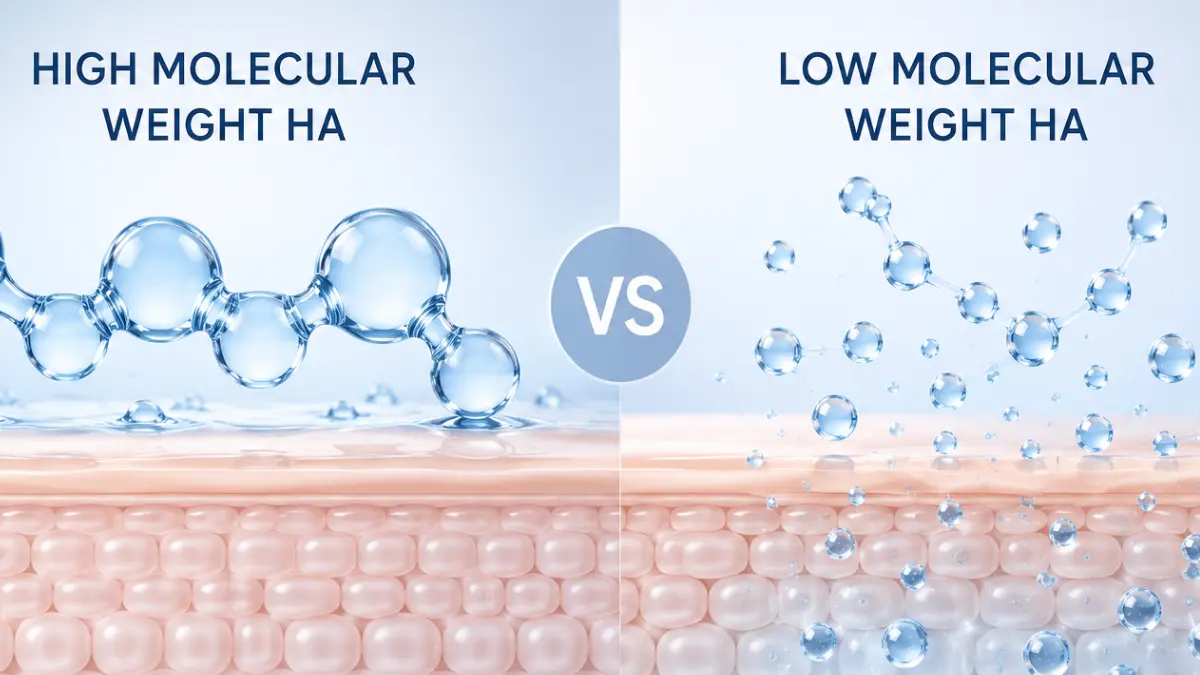
High Molecular Weight Hyaluronic Acid consists of large molecules, typically above 1,000 kDa. Due to their size, these molecules remain primarily on the surface of the skin instead of moving into the upper layers of the epidermis.
Once applied, High Molecular Weight Hyaluronic Acid forms a lightweight, breathable film that attracts moisture to the skin while helping reduce transepidermal water loss (TEWL). This creates immediate hydration, leaving the skin feeling softer, smoother, and more comfortable.
Because it works mainly on the skin’s surface, High Molecular Weight Hyaluronic Acid is widely used in moisturisers, hydrating serums, facial mists, sheet masks, barrier creams, and after-sun products.
Benefits of High Molecular Weight Hyaluronic Acid
- Provides immediate surface hydration.
- Helps reduce moisture loss throughout the day.
- Supports the skin’s natural moisture barrier.
- Leaves the skin feeling smoother and softer.
- Helps relieve feelings of dryness and tightness.
- Well suited to sensitive, dry, and dehydrated skin.
- Creates a protective moisture film on the skin.
What Is Low Molecular Weight Hyaluronic Acid?
Low Molecular Weight Hyaluronic Acid is made up of much smaller molecules, generally below 200 kDa. Because these molecules are smaller, they can move further into the upper layers of the epidermis than high molecular weight hyaluronic acid.
Instead of mainly forming a protective film on the skin’s surface, Low Molecular Weight Hyaluronic Acid helps deliver hydration within the upper layers of the skin. This makes it popular in products formulated to improve skin hydration beyond the immediate surface.
Low Molecular Weight Hyaluronic Acid is commonly found in anti-ageing serums, intensive hydrating treatments, lightweight gels, and advanced moisturisers. It is often combined with High Molecular Weight Hyaluronic Acid to provide hydration at multiple levels.
Benefits of Low Molecular Weight Hyaluronic Acid
- Hydrates the upper layers of the epidermis.
- Helps improve skin suppleness and elasticity.
- Leaves skin feeling plumper and smoother.
- Provides longer-lasting hydration within the skin.
- Works well in lightweight formulations.
- Commonly used in anti-ageing skincare.
- Complements High Molecular Weight Hyaluronic Acid in multi-molecular formulations.
High Molecular Weight Hyaluronic Acid vs Low Which Is Better?
Neither form is better than the other, they simply perform different functions. If your goal is to improve surface hydration, reduce moisture loss, and support the skin barrier, High Molecular Weight Hyaluronic Acid is an excellent choice.
If you’re looking to deliver hydration further into the upper layers of the skin and improve skin softness and elasticity, Low Molecular Weight Hyaluronic Acid is more suitable. Many modern skincare products combine both molecular weights to provide multiple layers of hydration. High Molecular Weight Hyaluronic Acid hydrates and protects the surface, while Low Molecular Weight Hyaluronic Acid helps maintain hydration within the upper layers of the epidermis.
Get the benefits of both High and Low Molecular Weight Hyaluronic Acid in our Hydrating Glide Serum.
Which Skin Types Benefit Most?
High Molecular Weight Hyaluronic Acid
Best suited for:
- Dry skin
- Sensitive skin
- Dehydrated skin
- Mature skin
- Compromised skin barrier
Low Molecular Weight Hyaluronic Acid
Best suited for:
- Dehydrated skin
- Normal skin
- Combination skin
- Mature skin
- Lightweight hydrating routines
Both forms can be used by oily skin because they provide hydration without adding oil.
Cosmetic Applications
High and Low Molecular Weight Hyaluronic Acid are widely used in cosmetic formulations, including:
- Facial serums
- Moisturisers
- Eye creams
- Hydrating gels
- Facial mists
- Sheet masks
- Barrier repair products
- After-sun products
- Overnight masks
They also work exceptionally well with ingredients such as glycerin, panthenol, beta-glucan, niacinamide, ceramides, aloe vera, allantoin, and polyglutamic acid.
High Molecular Weight Hyaluronic Acid vs Low: Formulation Tips
Whether using High Molecular Weight or Low Molecular Weight Hyaluronic Acid:
- Hydrate the powder fully before adding additional ingredients.
- Add during the cool-down phase where appropriate.
- Avoid rapid mixing that may introduce excessive air.
- Formulate within the supplier’s recommended pH range.
- Pair with other humectants for improved hydration performance.
Many formulators combine different molecular weights of hyaluronic acid in a single product to provide both immediate surface hydration and hydration within the upper layers of the skin.
How Much Hyaluronic Acid Powder You Actually Need
This is the part most DIY guides skip, and it matters: hyaluronic acid powder is used at very low percentages — typically 0.1% to 2% of a formula. More is not better. Above roughly 2%, HA solutions become thick and gel-like without adding extra hydration benefit, and can actually feel tacky or heavy on skin.
For a first DIY serum, 0.2% is a sensible starting point — enough to see a real hydration effect without fighting the texture. Our Five DIY Hydrating Serums guide walks through exact ratios if you want a tested starting formula rather than guessing.
High Molecular Weight Hyaluronic Acid vs Low FAQ
Does hyaluronic acid powder expire?
Yes — once dissolved into a water-based serum, treat it like any other formulation and use it within the timeframe your preservative system supports (unpreserved DIY serums should generally be used within a few weeks, kept refrigerated).
Can you use too much hyaluronic acid?
Not in the sense of harm — HA doesn’t carry a toxicity risk tied to proportion — but overloading a formula past roughly 2% mostly just wastes product and makes the texture unpleasant, without extra hydration benefit.
Is hyaluronic acid powder the same as the acid used in dermal fillers?
Chemically related (both are forms of hyaluronic acid), but formulated completely differently — filler-grade HA is cross-linked and injected; skincare-grade HA powder is dissolved topically and works at the skin’s surface and upper layers, not beneath it.
What’s the difference between hyaluronic acid and sodium hyaluronate?
Sodium hyaluronate is the salt form of hyaluronic acid — smaller, more stable, and generally what you’re actually getting in a “hyaluronic acid” skincare powder, since it dissolves more easily into water-based formulas.