Granactive Retinoid vs Retinol: Which is Safer for SA Skin?

Granactive Retinoid vs Retinol: Which is Safer for SA Skin? This is a question every South African should ask before starting an anti-aging routine.
It’s very common to hear the words Retinol, Granactive Retinoid, Retinyl Palmitate, and Retinal used interchangeably, as if they all mean the same thing, but they don’t. These are not identical ingredients, and they do not behave the same on the skin.
Another important correction is that retinol is not the umbrella term. The correct umbrella term is RETINOIDS. Retinoids are the entire family of vitamin A derivatives. Under this umbrella, you get different types of retinoids, each with different strengths, conversion steps, irritation potential, and effectiveness.
Table of Contents Granactive Retinoid vs Retinol: Which is Safer for SA Skin?
- What Do Retinoids Actually Do?
- The Retinoid Family Explained
- Anti-Aging for Skin of Colour
- Why This Matters for You
- Frequently Asked Questions
What do Retinoids actually do?
In simple terms, Retinoids are the “communication signals” for your skin cells. As we age, and especially under our harsh South African sun, our skin’s natural renewal process slows down. Retinoids work by diving deep into the skin to tell your cells to “speed up” their turnover. This pushes fresh, healthy cells to the surface while stimulating collagen production in the deeper layers. The result is a skin remodel: pores appear smaller, texture becomes smoother, and the “disorganized” melanin that causes dark patches and spots is gradually shed away.
These include ingredients like retinyl esters (such as retinyl palmitate), retinol, retinal (retinaldehyde), Granactive retinoid (hydroxypinacolone retinoate), and prescription retinoic acid. Each one works differently and suits different skin types and tolerance levels.
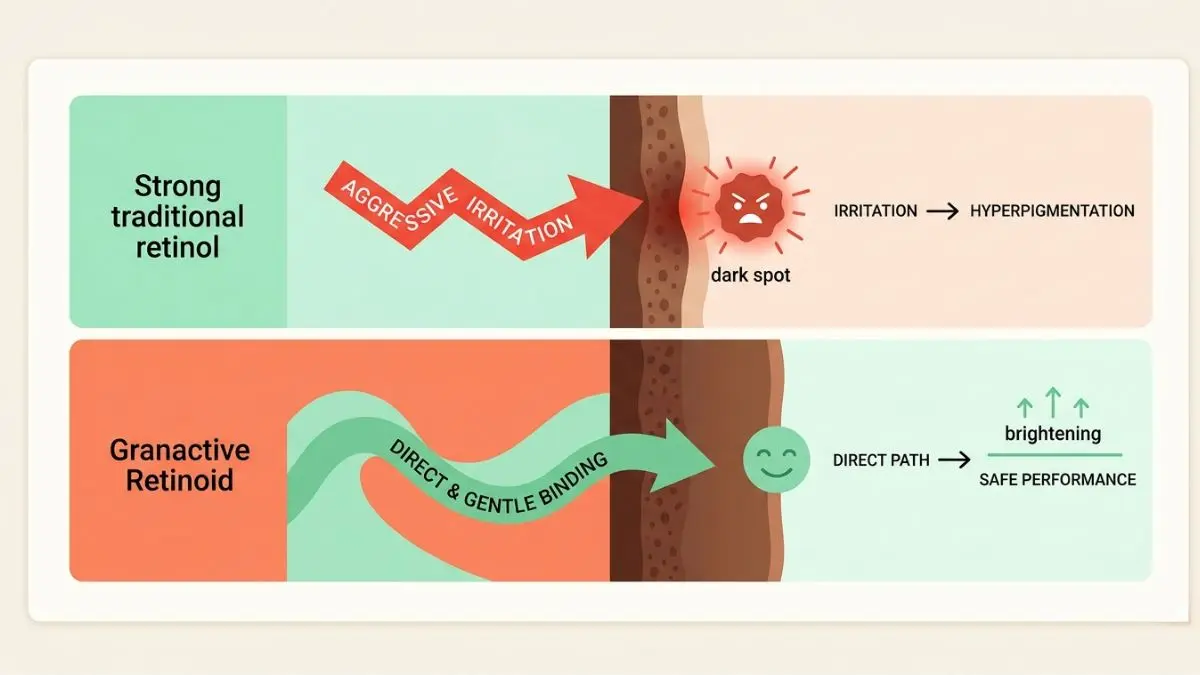
This matters especially for South African skin, because skin tone, sensitivity, and tolerance levels vary, and stronger is not always better. Choosing the wrong retinoid, or starting too aggressively, can lead to irritation, and in skin of color, irritation can trigger post-inflammatory hyperpigmentation, which is the opposite of what most people are trying to achieve.
So before deciding which one is “best,” it’s important to understand that all retinoids are not equal, and the safest choice depends on your skin tone, your tolerance, and what your skin actually needs.
The Retinoid Family- Granactive Retinoid vs Retinol
In the world of Vitamin A, stronger is not always better, especially in our harsh South African sun. For South Africans who have hyperpigmentation or melasma, and for those who are Indian, Black, or Coloured, “stronger” can actually be terrible for your skin. If you have sensitive skin, the wrong type of retinoid can accidentally cause darkening of the skin, which is the exact opposite of what you want.
To make a sound judgment, you must understand where each ingredient sits on the “power scale”.
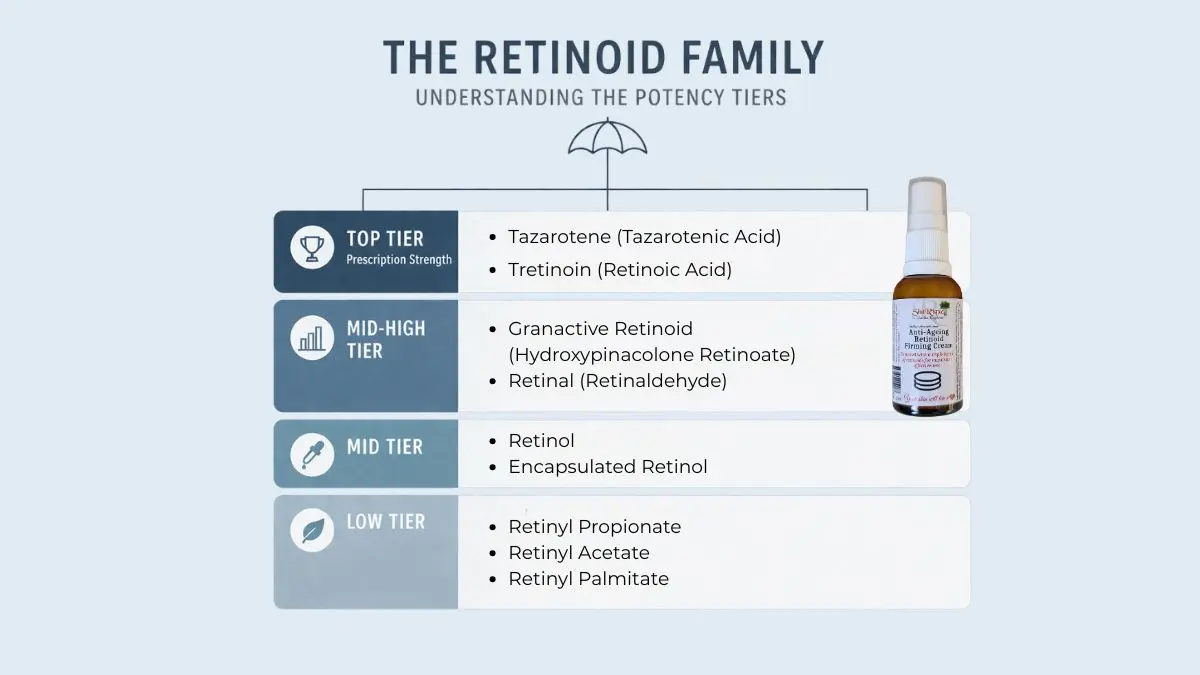
CAPTION: The Retinoid Hierarchy: From prescription-strength Tazarotene to gentle Retinyl Palmitate. In my experience formulating for South African skin types, choosing the correct “tier” is more important than choosing the highest percentage.
Top Tier, Prescription Strength (Most Potent, Highest Irritation Risk)
These are the most potent forms of Vitamin A. Because they are classified as Scheduled Medicines in South Africa, you cannot buy them over the counter at a pharmacy or in a retail shop. You need a medical script from a doctor or dermatologist to access them, because of the side effects.
While they offer the highest power, they also carry the highest risk of “Retinoid Dermatitis”, extreme peeling and redness that can lead to permanent dark marks if used incorrectly under the South African sun.
Tazarotene: The strongest commonly used topical retinoid.
Tretinoin (Retinoic Acid): The medical gold standard.
Mid-High Tier: The Direct-Acting Cosmetic Retinoid (The SA Sweet Spot)
This is a modern breakthrough in skin science. It is strong enough to give visible results but designed to be much kinder to the skin barrier than traditional options.
Granactive Retinoid (Hydroxypinacolone Retinoate): This is a “shortcut” ingredient. Unlike standard retinol, it binds more directly to your skin’s receptors, skipping the irritation steps that often lead to “Retinol Burn”.
- Retinal (Retinaldehyde): It is much more powerful than standard retinol (requiring only one conversion step), yet it is remarkably well-tolerated. Clinical data shows it has a much lower risk of the inflammation that triggers darkening, making it a safer high-potency option for skin of color. It is also a costly ingredient to formulate with.
When I researched how to create the best performing and safest anti aging formula for skin of colour, I chose Granactive Retinoid as the hero for our Anti-Aging Retinoid Firming Cream. It is not a common ingredient in mass-market products because it is an expensive, premium active. However, for South Africans dealing with hyperpigmentation and melasma, this investment ensures you get high-tier results without the risk of darkening your skin.
Mid Tier – Strong Cosmetic Retinoids
These are the most common retinoids found in shops like Clicks or Dis-Chem. They must be “converted” by your skin’s enzymes before they can actually work.
- Retinol: This is the most famous type, but it requires two conversion steps. This “work” by the skin often leads to the redness and peeling that can accidentally cause post-inflammatory hyperpigmentation in Indian, Black, and Coloured skin.
Encapsulated Retinol: This is a specialised, “slow-release” version of retinol. Because the ingredient is housed in a tiny protective shell, it doesn’t hit the skin all at once. Instead, it is released slowly over several hours, which drastically reduces the risk of “Retinol Burn”. I specifically included Encapsulated Retinol in our Anti-Aging Retinoid Firming Cream to ensure deep penetration without the surface trauma that leads to hyperpigmentation. It is also important to remember that if you are using a retinoid on your face, you should extend that care to your body; otherwise, your facial skin will eventually appear much younger than the skin on your neck and limbs. This is why we have also formulated our Anti-Aging Retinol Body Cream , to ensure a firm, youthful appearance from head to toe.
Low Tier – Weak Cosmetic Retinoids (Multiple Conversion Steps)
These are the “starter” retinoids. Because they must undergo several conversion steps before the skin can use them, they are significantly milder. However, they are a fantastic option for skin of colour and those with sensitive skin.
In my investigative research, I’ve found that for Indian, Black, and Coloured skin, “slow and steady” is often the only way to avoid the inflammation that leads to permanent dark spots. These gentle retinoids provide consistent benefits over time without the aggressive peeling of prescription-strength products.
Retinyl Propionate
Retinyl Acetate
Retinyl Palmitate (The gentlest): This is the mildest form of Vitamin A. I specifically included Retinyl Palmitate in our Anti-Aging Retinoid Firming Cream to act as a gentle “buffer” alongside our more potent actives.
Anti-Aging for Indian, Black, and Coloured Skin
If you have Indian, Black, or Coloured skin, the standard “Anti-Aging” advice you see online can be ruin your skin. In South Africa, the biggest risk isn’t just a few wrinkles, it is Post-Inflammatory Hyperpigmentation (PIH).
When you use a “strong” traditional retinol, it often causes inflammation. For melanin-rich skin, the body treats that inflammation as an injury, which triggers the skin to produce more pigment. This is why many South Africans find their hyperpigmentation, Chubaba and melasma getting darker after starting a retinoid.
The “Safe-Performance” Audit
When I researched how to formulate the Anti-Aging Retinoid Firming Cream specifically for our skin types, I looked for ingredients that perform without the “rebound” darkening.
Tetrahexyldecyl Ascorbate (Stable Vitamin C): We chose this specific, oil-soluble form of Vitamin C because it is non-acidic. It boosts collagen and brightens the skin without the “sting” that triggers sensitivity in Indian and Black skin.
Ubiquinol (Q10): This is a critical “Energy Buffer”. It protects your cells from the oxidative stress of the South African sun, ensuring the skin stays resilient and firm while the retinoids work.
The “Triple-Threat” Delivery: By combining Granactive Retinoid, Encapsulated Retinol, and Retinyl Palmitate, we ensure the skin is never “shocked” into an inflammatory response.
Why This Matters for You
By using these high-tier, actives alongside Ceramide NP and Licorice Root, we created a formula that respects the biology of your skin. It provides the firming results you want without the risk of the “Retinol Burn” that leads to permanent dark marks.