
How Long Does It Take for Hyperpigmentation to Fade?

How Long Does It Take for Hyperpigmentation to Fade?
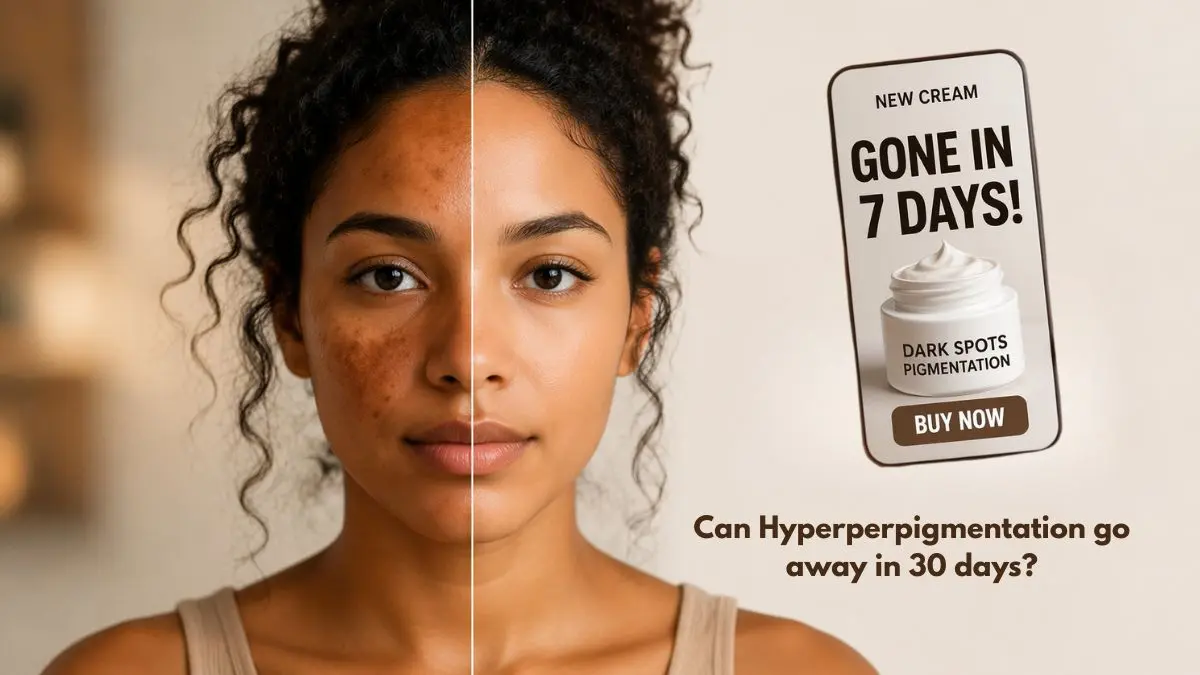
If you are scrolling through social media and see an advert promising that your pigmentation will be “gone in 7 days,” you are being lied to. It is biologically impossible.
Whether you call it dark spots, melasma, hyperpigmentation or what is referred to regionally in South Africa as Chubaba, your skin is not a stain that can be bleached away overnight. It is a living organ with a fixed biological clock. If your hyperpigmentation has been there for years, it is likely dermal (trapped deep), and no “miracle cream” can skip the mandatory 28-day shedding cycle. To understand why your treatment “isn’t working,” we must look at the reality of the science and the cellular conveyor belt that dictates your results.
READ: Epidermal vs Dermal Hyperpigmentation
Table of Contents for How Long Does It Take for Hyperpigmentation to Fade?
- Quick Answers, How Long Does it Take for my Melasma to Fade.
- How Long Does It Take for Hyperpigmentation to Fade with Vitamin C?
- How Long Does It Take for Hyperpigmentation to Fade with Niacinamide?
- How Long Does It Take for Hyperpigmentation to Fade with Retinoids?
- Conclusion: How Long Does It Take for Hyperpigmentation to Fade?
- Questions & Answers: How Long Does It Take for Hyperpigmentation to Fade ?
Naturally, your skin relies entirely on its Desquamation (shedding) process. For a healthy adult, it takes approximately 28 to 30 days for a new skin cell to be born in the basal layer and travel to the surface where it is shed. This is the “Natural Timeline” for a single layer of skin.
The Timeline of Truth: Now, when it comes to getting rid of hyperpigmentation, this does not mean your spots will disappear in 30 days. It is biologically impossible for them to vanish that quickly. Why? Because hyperpigmentation is a “backlog” of pigment packed into multiple layers of your skin.
To see a visible change, you don’t just need one cell to move; you need 3 to 4 full skin cycles (90 to 120 days) of consistent treatment to push that pigmented backlog out.
Furthermore, if you have been suffering with dark patches for years, that pigment is likely no longer just on the surface—it has leaked into the deep dermis. On this level, there is no 30-day conveyor belt. You are no longer waiting for a skin cycle; you are waiting for your internal “Clean-up Crew” (Macrophages) to slowly process the waste.
This is why your treatment won’t work overnight:
The Trigger Rule: You first have to stop the triggers (UV, heat, inflammation) and calm the melanocytes. Only once the factory is calm will your treatment actually start working.
The Reset: If you are still fueling the melanocytes with sun exposure or irritation, you are simply resetting your 30-day clock every single morning.
This shedding clock is strictly influenced by age:
Children: 14–21 days
Adults (20s–30s): 28–30 days
Adults (40s–50s): 30–45 days
Over 50: 60+ days
If you are over 50, your skin takes nearly twice as long to renew itself. This isn’t a failure of your cream; it’s just your biology moving slower. While your skin takes its time, clinical treatments like microneedling can help speed up this slow cycle. For anyone who wants to learn how to do this safely at home or in a clinic, I outline the exact steps in the Professional Microneedling Training Manual.
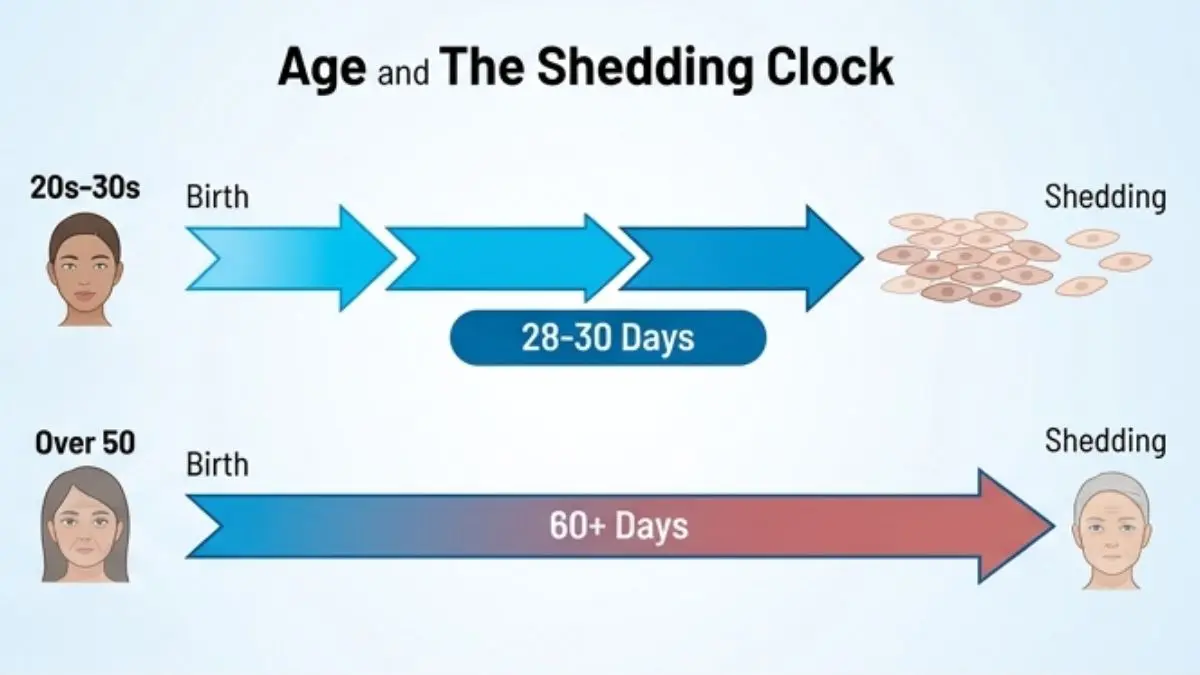
Caption: Your biology dictates the results. While young skin renews in 30 days, mature skin takes 60+ days to surface and shed.
How Long Does It Take for Hyperpigmentation to Fade? Quick Answers.
- Mild dark spots (Epidermal): 4–8 weeks. This pigment is near the surface and sheds with your standard 28-day cycle.
- Moderate hyperpigmentation: 8–12 weeks. This requires halting the factory and waiting for multiple shedding cycles to clear the “backlog”.
- Stubborn Melasma / Dermal Pigment: 3–9 months, running into years.
- The Truth: However, unlike your surface skin, these clean-up cells called Macrophages do not shed. They stay stuck in the deep layers of your skin. This is why you cannot “scrub” or “peel” away deep patches like Melasma or deep-seated dermal pigmentation (known as Chubaba in some regions). You aren’t waiting for skin to fall off; you are waiting for these internal cells to slowly digest and move that pigment out. This is a slow, biological process that takes 3 to 9 months to even years, which is why consistency is your only path to success.
- Without Sunscreen: May not fade at all.
How Long Does It Take for Hyperpigmentation to Fade with Vitamin C?
Vitamin C acts as a biological skin brightener by chemically “de-colorizing” dark oxidized melanin and inhibiting the tyrosinase enzyme to slow the production of new pigment at the source.
The Timeline: Expect to see a change in overall brightness in 4 to 6 weeks.
The Reality Check: You cannot treat hyperpigmentation with Vitamin C alone. Why? Because while Vitamin C is busy neutralizing free radicals at the surface, it does very little to stop the “internal heat” or the vascular triggers (blood vessels) that drive Melasma. If you have a “leaky” basal membrane, Vitamin C cannot “seal” it. It is a piece of the puzzle, not the whole picture. Without a barrier repair cream and a direct pigment blocker like 4-Butylresorcinol, the factory will simply outpace the Vitamin C.
The Formulation Risk: Traditional Vitamin C (L-Ascorbic Acid) is highly unstable. To force it to penetrate the skin barrier, formulators must drop the pH to a highly acidic level (usually pH 2.5 to 3.0). For those with melanin-rich skin, including Indian, Black, and South African ‘Coloured’ demographics (Fitzpatrick IV, V, and VI), this extreme acidity is an irritant. Because irritation is the primary trigger for melanocytes, a low-pH serum can cause micro-inflammation. This triggers Post-Inflammatory Hyperpigmentation (PIH). You are essentially “hammering” your skin with acid, which signals the factory to produce more melanin as a defense mechanism.
This is why, from a formulation standpoint, I prefer lipid-soluble derivatives like Tetrahexyldecyl Ascorbate or Sodium Ascorbyl Phosphate.
The Benefit: These forms are stable at a skin-compatible pH which closely matches the skin’s natural acid mantle.
The Result: You get the “de-colorizing” and antioxidant benefits without the inflammatory “burn” that restarts the pigmentation cycle.
How Long Does It Take for Hyperpigmentation to Fade with Niacinamide?
Niacinamide (Vitamin B3) addresses both the symptom and the structural cause of dark spots.
The Timeline: 8 to 12 weeks for significant visible change.
The Science: It prevents the “delivery trucks” (melanosomes) from handing over melanin to your keratinocytes (surface skin cells).
The Reality Check: Niacinamide does not stop the production of melanin; it only stops the distribution. If you are only blocking the delivery but the factory is still working at 100% capacity, the pigment will simply “pile up” at the basal layer. This often leads to a “rebound” effect where the moment you stop the Niacinamide, all that stored pigment rushes to the surface at once. You must pair it with a Tyrosinase inhibitor like the Melanin Breaker to shut down the factory itself.
How Long Does It Take for Hyperpigmentation to Fade with Retinoids?
Retinoids are the experts at forcing your 28-day shedding cycle to move faster.
The Timeline: 12 to 16 weeks for deep structural changes.
The Science: They improve communication between the layers of your skin and force the cellular conveyor belt to speed up.
The Risk: Using retinoids alone on skin of colour is often the fastest way to make your spots darker. Unless you have calmed the internal heat and repaired the barrier, the retinoid causes micro-inflammation. Your melanocytes will view this as an “attack” and produce more melanin as a defense.
Retinoids are powerful, but if you don’t use them correctly, you can end up with more dark patches than you started with. They must be “cushioned” by anti-inflammatories and supported by pigment blockers to actually work.
Conclusion: How Long Does It Take for Hyperpigmentation to Fade?
The “Timeline of Truth” is not a suggestion, it is a biological mandate. Whether you are waiting 28 days for a surface spot to shed or 9 months or more for immune cells (macrophages) to slowly process trapped dermal pigment, the speed of your recovery is dictated by how many “leaks” you have left open in your skin’s defense system.
To truly treat hyperpigmentation, you must stop shopping for “silver bullets” and start paying attention to the synergy of your ingredients. If you are using a high-strength Vitamin C but ignoring your broken barrier, or using a Retinoid but “hammering” your skin into constant inflammation, you are effectively resetting your own clock every single day.
If you do not address the six-part biological loop, stopping the factory, blocking the delivery (to the keratinocytes), calming the internal heat, and repairing the “leaky” membrane, your hyperpigmentation will stay exactly where it is. It may even darken. You cannot “scrub” your way out of a cellular signaling problem.
Success requires moving beyond the surface. You must treat your skin as a living organ that needs a calm, protected environment to heal. This includes wearing a high-factor sunscreen and reapplying it every 3 to 4 hours to ensure the UV trigger is completely halted. If you are tired of waiting for results that never come, it is time to stop guessing and start understanding the mechanical “Why” behind your dark spots.
To understand how these triggers work and how to build a routine that actually closes the factory doors, read Melasma and Hyperpigmentation: Causes, Treatments, and How to Fade Dark Patches.