Granactive Retinoid vs Retinol: Which is Safer?
Short answer: Granactive Retinoid isn’t the same as retinol. Both belong to the vitamin A family, but retinol must be converted by your skin before it works. Granactive Retinoid (hydroxypinacolone retinoate, or HPR) is an ester of retinoic acid that is described as binding directly to the skin’s retinoid receptors. It’s known for being gentle and stable.
Looking for a Granactive night cream? Our Retinol Smoothing & Firming Face Cream combines Granactive Retinoid, encapsulated retinol and retinyl palmitate. Shop the face cream
Granactive Retinoid vs Retinol: Which is Safer? This is a question every individual in high-UV environments should ask before starting an anti-aging routine.
It’s very common to hear the words Retinol, Granactive Retinoid, Retinyl Palmitate, and Retinal used interchangeably, as if they all mean the same thing, but they don’t. These are not identical ingredients, and they do not behave the same on the skin.
Another important correction is that retinol is not the umbrella term. The correct umbrella term is RETINOIDS. Retinoids are the entire family of vitamin A derivatives. Under this umbrella, you get different types of retinoids, each with different strengths, conversion steps, irritation potential, and effectiveness.
Table of Contents Granactive Retinoid vs Retinol: Which is Safer?
- What Do Retinoids Actually Do?
- The Retinoid Family Explained
- Anti-Aging for Skin of Colour
- Why This Matters for You
- Is Granactive Retinoid the Same as Retinol?
- Is It Better or Stronger?
- Granactive Retinoid vs Retinal
- Is It as Good as Tretinoin?
- What Do Dermatologists Say?
- Which Retinoid Is Best for Skin of Colour?
- Frequently Asked Questions
What do Retinoids actually do?
In simple terms, Retinoids are the “communication signals” for your skin cells. As we age, and especially under intense UV exposure, our skin’s natural renewal process slows down. Retinoids work by diving deep into the skin to tell your cells to “speed up” their turnover. This pushes fresh, healthy cells to the surface while stimulating collagen production in the deeper layers. The result is a skin remodel: pores appear smaller, texture becomes smoother, and the “disorganized” melanin that causes dark patches and spots is gradually shed away.
Crepey arms, legs or chest? Our Retinol Smoothing Body Cream brings face-grade retinoids to your body to smooth fine lines and crepey texture. Shop the retinol body cream Or browse all our body care.
These include ingredients like retinyl esters (such as retinyl palmitate), retinol, retinal (retinaldehyde), Granactive retinoid (hydroxypinacolone retinoate), and prescription retinoic acid. Each one works differently and suits different skin types and tolerance levels.
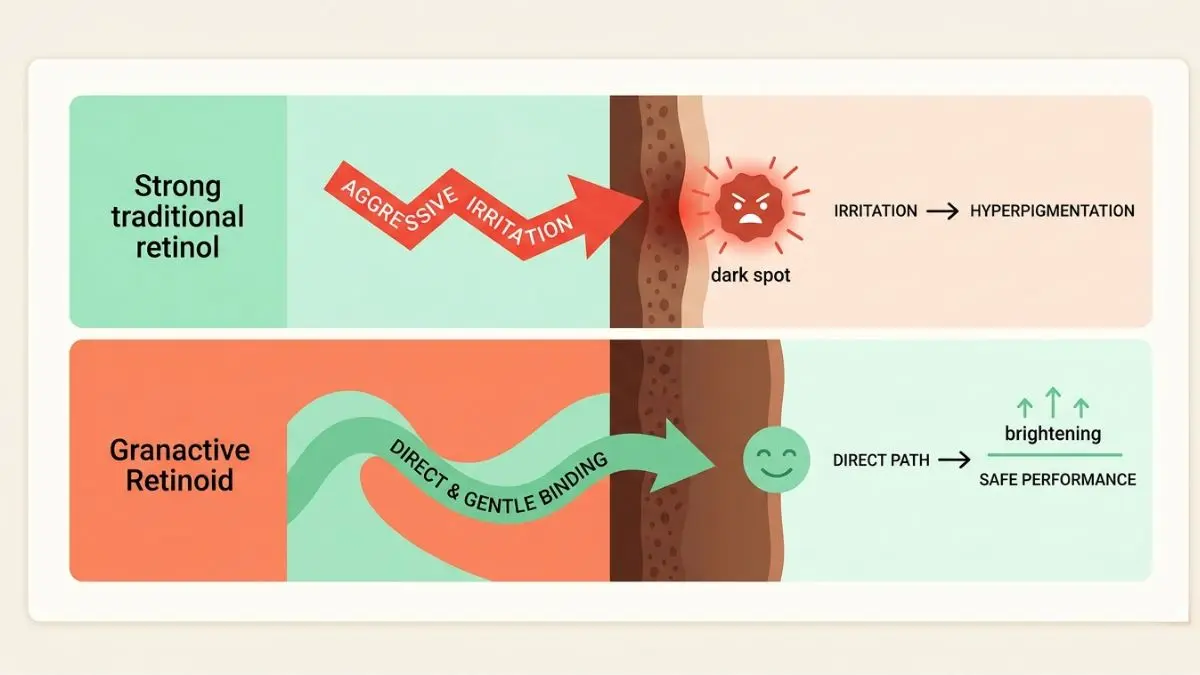
This matters especially for melanin-rich skin, because skin tone, sensitivity, and tolerance levels vary, and stronger is not always better. Choosing the wrong retinoid, or starting too aggressively, can lead to irritation, and in skin of color, irritation can trigger post-inflammatory hyperpigmentation, which is the opposite of what most people are trying to achieve.
So before deciding which one is “best,” it’s important to understand that all retinoids are not equal, and the safest choice depends on your skin tone, your tolerance, and what your skin actually needs.
The Retinoid Family- Granactive Retinoid vs Retinol
In the world of Vitamin A, stronger is not always better, especially under intense UV exposure. For melanin-rich skin types, including those of Indian, Black, and Coloured descent, “stronger” can actually be terrible for your skin. If you have sensitive skin, the wrong type of retinoid can accidentally cause darkening of the skin, which is the exact opposite of what you want.
To make a sound judgment, you must understand where each ingredient sits on the “power scale”.
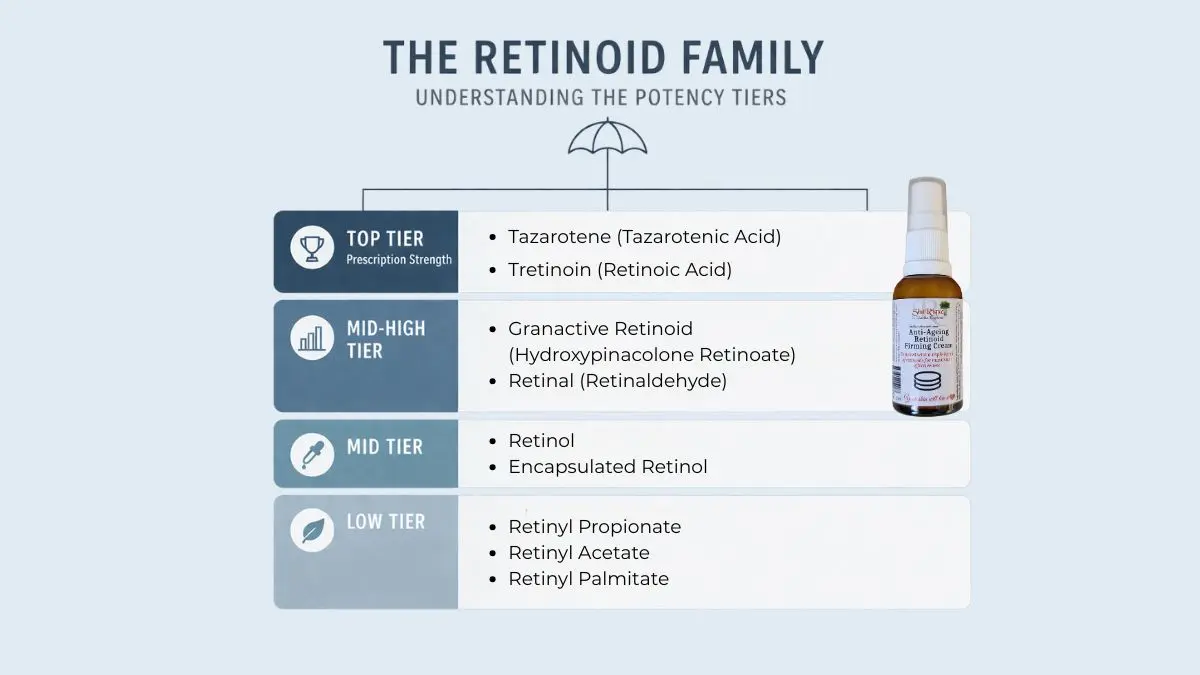
Top Tier Retinoids, Prescription Strength (Most Potent, Highest Irritation Risk)
These are the most potent forms of Vitamin A. Because they are classified as Scheduled Medicines in certain countries, you cannot buy them over the counter at a pharmacy or in a retail shop. You need a medical script from a doctor or dermatologist to access them, because of the side effects.
While they offer the highest power, they also carry the highest risk of “Retinoid Dermatitis”, extreme peeling and redness that can lead to permanent dark marks if used incorrectly under intense UV exposure.
Tazarotene: The strongest commonly used topical retinoid.
Tretinoin (Retinoic Acid): The medical gold standard.
Mid-High Tier: The Direct-Acting Cosmetic Retinoid
This is a modern breakthrough in skin science. It is strong enough to give visible results but designed to be much kinder to the skin barrier than traditional options.
Granactive Retinoid (Hydroxypinacolone Retinoate): This is a “shortcut” ingredient. Unlike standard retinol, it binds more directly to your skin’s receptors, skipping the conversion steps retinol needs.
- Retinal (Retinaldehyde): It is much more powerful than standard retinol (requiring only one conversion step), yet it is remarkably well-tolerated. In one study, it was well tolerated while retinoic acid caused more local irritation. It is also a costly ingredient to formulate with.
When I researched how to create the best performing and safest anti aging formula for skin of colour, I chose Granactive Retinoid as the hero for our Retinol Smoothing & Firming Face Cream. It is not a common ingredient in mass-market products because it is an expensive, premium active. However, for people with skin of colour dealing with hyperpigmentation and melasma, it’s a gentler choice that helps you get visible results.
Mid Tier – Strong Cosmetic Retinoids
These are the most common retinoids found in shops like Clicks or Dis-Chem. They must be “converted” by your skin’s enzymes before they can actually work.
- Retinol: This is the most famous type, but it requires two conversion steps. This “work” by the skin often leads to the redness and peeling that can accidentally cause post-inflammatory hyperpigmentation in skin of colour.
Encapsulated Retinol: This is a specialised, “slow-release” version of retinol. Because the ingredient is housed in a tiny protective shell, it doesn’t hit the skin all at once. Instead, it is released slowly over several hours, which drastically reduces the risk of “Retinol Burn”. I specifically included Encapsulated Retinol in our Retinol Smoothing & Firming Face Cream to ensure deep penetration without the surface trauma that leads to hyperpigmentation. It is also important to remember that if you are using a retinoid on your face, you should extend that care to your body; otherwise, your facial skin will eventually appear much younger than the skin on your neck and limbs. This is why we have also formulated our Retinol Smoothing Body Cream , to ensure a firm, youthful appearance from head to toe.
Gentle Cosmetic Retinoids (Multiple Conversion Steps)
These are the “starter” retinoids. Because they must undergo several conversion steps before the skin can use them, they are significantly milder. However, they are a fantastic option for skin of colour and those with sensitive skin.
In my investigative research, I’ve found that for skin of colour, “slow and steady” is often the only way to avoid the inflammation that leads to permanent dark spots. These gentle retinoids provide consistent benefits over time without the aggressive peeling of prescription-strength products.
Retinyl Propionate
Retinyl Acetate
Retinyl Palmitate (The gentlest): This is the mildest form of Vitamin A. I specifically included Retinyl Palmitate in our Retinol Smoothing & Firming Face Cream to act as a gentle “buffer” alongside our more potent actives.
Is Granactive Retinoid the same as retinol?
No. Retinol takes two steps to become retinoic acid, the form your skin uses. Granactive Retinoid skips those steps. Check the label too: the commercial ingredient is about 10% HPR, so “2% Granactive” means roughly 0.2% HPR.
Is Granactive Retinoid better or stronger than retinol?
Dermatologist Dr Sam Bunting gives three reasons for choosing it rather than retinol: it needs no conversion steps to get activated, it is much more stable, and it balances strong and gentle. In an 8-week study, 31 women used a serum with retinol, HPR and peptides. Wrinkles, elasticity and hydration improved, with only mild, passing dryness or redness. The study was funded by a cosmetics company, Proya.
Granactive Retinoid vs retinal: what’s the difference?
Retinal (retinaldehyde) is one step from retinoic acid. In a study of 125 people, 40 used 0.05% retinal and 40 used 0.05% tretinoin. Both reduced wrinkles, and retinal was better tolerated. Where does Granactive fit? Dr Sam Bunting writes that 2% Granactive Retinoid contains 0.2% HPR, “which is equivalent to 0.2% retinaldehyde in potency”.
Is Granactive Retinoid as good as tretinoin?
Tretinoin (prescription retinoic acid) has the strongest evidence, supported by a review of clinical trials. Granactive Retinoid is its ester, so the two are closely related. Dr Davin Lim writes that, as of 2021, most papers* suggest HPR is better than retinol, with “clinical outcomes comparable to prescription retinoids like tretinoin” and less irritation and redness.
*Dr Lim’s footnote: the papers were research undertaken by L’Oréal.
What is retinyl palmitate?
It’s also an ester, but of retinol. It takes more steps to convert, which makes it one of the gentlest choices and a lovely partner to other retinoids. See our Retinyl Palmitate.
What do dermatologists say about Granactive Retinoid?
We follow dermatologist Dr Sam Bunting, who calls Granactive Retinoid “truly the modern retinoid”. These are her three reasons for choosing it rather than retinol:
- It’s already active. She describes it as “the ester of the gold standard retinoid, tretinoin”, so it is biologically active and doesn’t need conversion steps.
- It’s stable. Retinol can lose much of its power over time, she explains, while Granactive Retinoid “is much more stable and lasts”.
- It’s strong and gentle. She calls it “a fantastic balance of strong and gentle” that reduces dark marks and pigmentation and lessens fine lines without disrupting the skin barrier.
She compares using a retinoid to climbing a ladder: you start on a lower rung, and over time you may go up a rung or two. Dr Bunting also sells a Granactive Retinoid serum.
Want Granactive Retinoid for your body? We’ll make your lotion in the strength you choose. Choose your strength, from R429
Anti-Aging for Skin of Colour
If you have skin of colour, the standard “Anti-Aging” advice you see online can ruin your skin. In high-UV environments, the biggest risk isn’t just a few wrinkles; it is Post-Inflammatory Hyperpigmentation (PIH).
When you use a “strong” traditional retinol, it often causes inflammation. For melanin-rich skin, the body treats that inflammation as an injury, which triggers the skin to produce more pigment. This is why many individuals in high-UV environments find their hyperpigmentation, dermal-pigment (Chubaba), and melasma getting darker after starting a retinoid.
The “Safe-Performance” Audit
When I researched how to formulate the Retinol Smoothing & Firming Face Cream specifically for skin of colour, I looked for ingredients that perform without the “rebound” darkening.
Tetrahexyldecyl Ascorbate (Stable Vitamin C): We chose this specific, oil-soluble form of Vitamin C because it is non-acidic. It boosts collagen and brightens the skin without the “sting” that triggers sensitivity in skin of colour.
Ubiquinol (Q10): This is a critical “Energy Buffer”. It protects your cells from the oxidative stress of intense UV exposure, ensuring the skin stays resilient and firm while the retinoids work.
The “Triple-Threat” Delivery: By combining Granactive Retinoid, Encapsulated Retinol, and Retinyl Palmitate, we ensure the skin is never “shocked” into an inflammatory response.
Why This Matters for You
By using these high-tier, actives alongside Ceramide NP and Licorice Root, we created a formula that respects the biology of your skin. It’s designed to firm while lowering the risk of the “Retinol Burn” that can lead to dark marks.
Which retinoid is best for skin of colour?
The one your skin tolerates. A review supports retinoids for dark marks in skin of colour, but irritation can cause new marks. Start slowly.
 Fine lines and firmness on the faceRetinol Smoothing & Firming Face CreamShop the face cream →
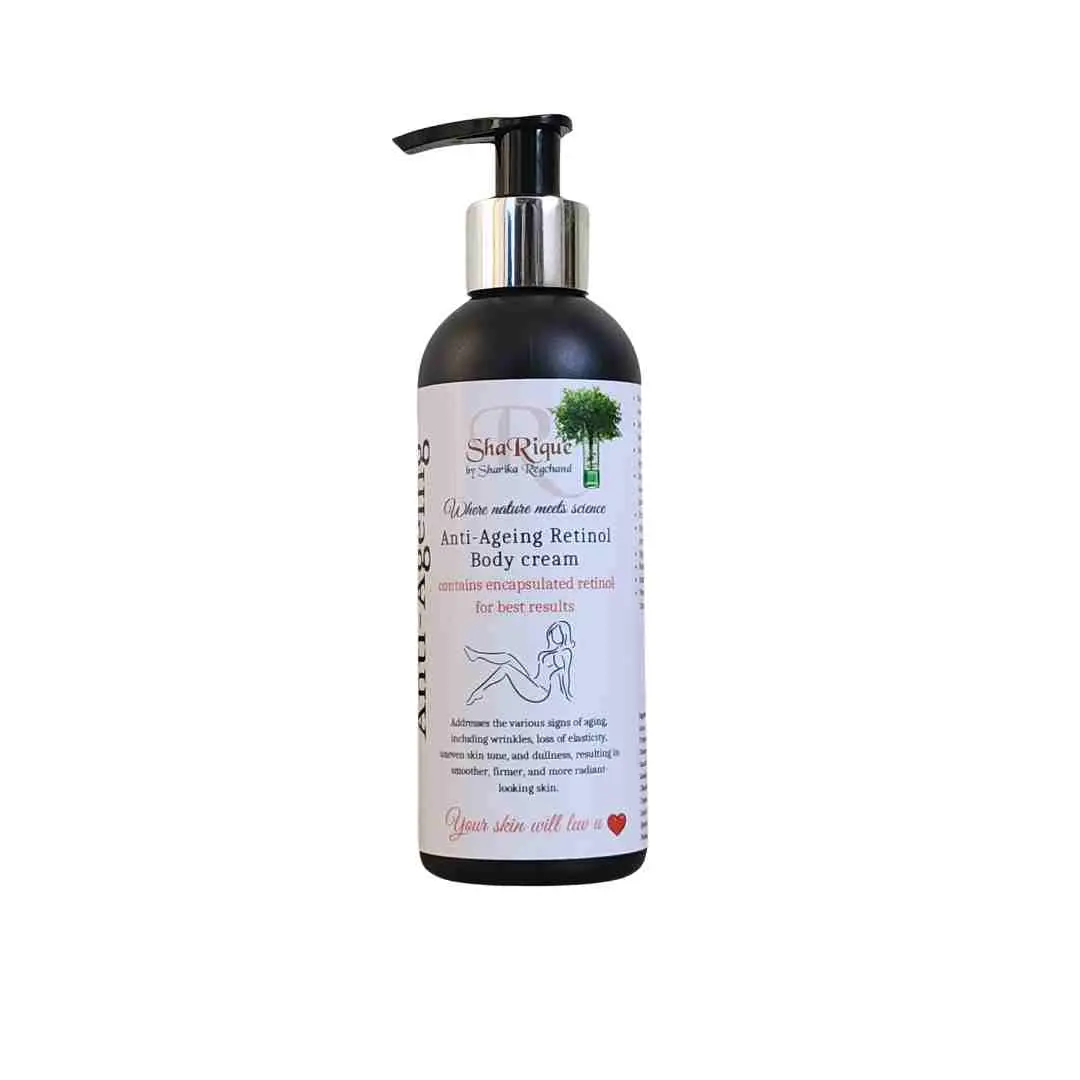 Crepey arms, legs and chestRetinol Smoothing Body CreamShop the body cream →
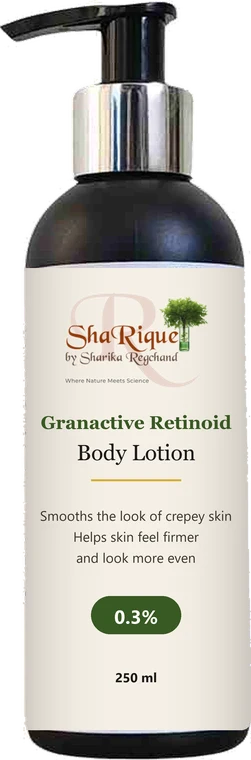 A premium retinoid for your bodyGranactive Retinoid Body LotionChoose your strength →The gentlest startProducts with retinyl palmitateSee the products →
Granactive Retinoid and Retinol FAQ
How often should I use a Granactive Retinoid cream?
Start with a small amount every third night and build up as your skin adjusts.
Can I use Granactive Retinoid with vitamin C?
Yes, when they are formulated together. Our Retinol Smoothing & Firming Face Cream combines Granactive Retinoid with a stable vitamin C.
Is Granactive Retinoid safe in pregnancy?
No. Avoid retinoids during pregnancy and breastfeeding.
Why does my skin “purge” with Top Tier retinoids but not gentle ones?
Top Tier retinoids like Tretinoin (Retinoic Acid) interact directly with cellular receptors, causing a rapid increase in cell turnover. This “rushes” existing micro-comedones to the surface, causing a temporary breakout. Gentle esters (like Retinyl Palmitate) require three conversion steps to become active, making them far gentler and less likely to trigger this inflammatory response.
What is the difference between Retinol and Encapsulated Retinol?
Standard Retinol is highly unstable and degrades when exposed to light or air. Encapsulated Retinol is housed in a microscopic “shell” that protects the molecule and allows for a slow, time-released delivery into the dermis. This ensures the active ingredient remains effective for longer and reduces the “hit” of irritation that often occurs with traditional OTC formulas.
Is “Top Tier” always better for anti-aging results?
Not necessarily. The “best” retinoid is the one your skin barrier can tolerate consistently. While Tretinoin is the gold standard for photo-aging, if it causes chronic peeling and inflammation, it can actually damage the skin barrier and worsen dark spots. A Mid-High Tier ingredient like Retinal (Retinaldehyde) or Granactive Retinoid often provides a superior balance of visible results without the downtime of a prescription.
Why are Retinyl Palmitate and Acetate considered gentle retinoids?
These are retinyl esters. To be used by the skin, they must convert to Retinol, then to Retinaldehyde, and finally into Retinoic Acid. That makes them gentle, a good choice for sensitive skin and a lovely partner to other retinoids.